Ethiopian Sidamo Coffee: Tasting Notes, Processing and How to Brew It
Your bag of Sidamo smells flat two weeks after it lands on your counter. That is not your grinder or your pour over technique. Coffee starts losing its peak aroma within days of roasting, so the roast date on the bag matters more than the origin printed above it.
This guide covers what makes Sidamo distinct, from the Sidama Zone's heirloom cultivars to the natural process behind its milk chocolate, caramel and fruit notes. You will also get brew ratios for pour over, French press and drip, plus a clear look at Kochere Coffee's Ethiopian Sidamo so you can decide whether it fits your morning cup.
What Is Kochere Coffee? A Roast-to-Order Specialty Roaster
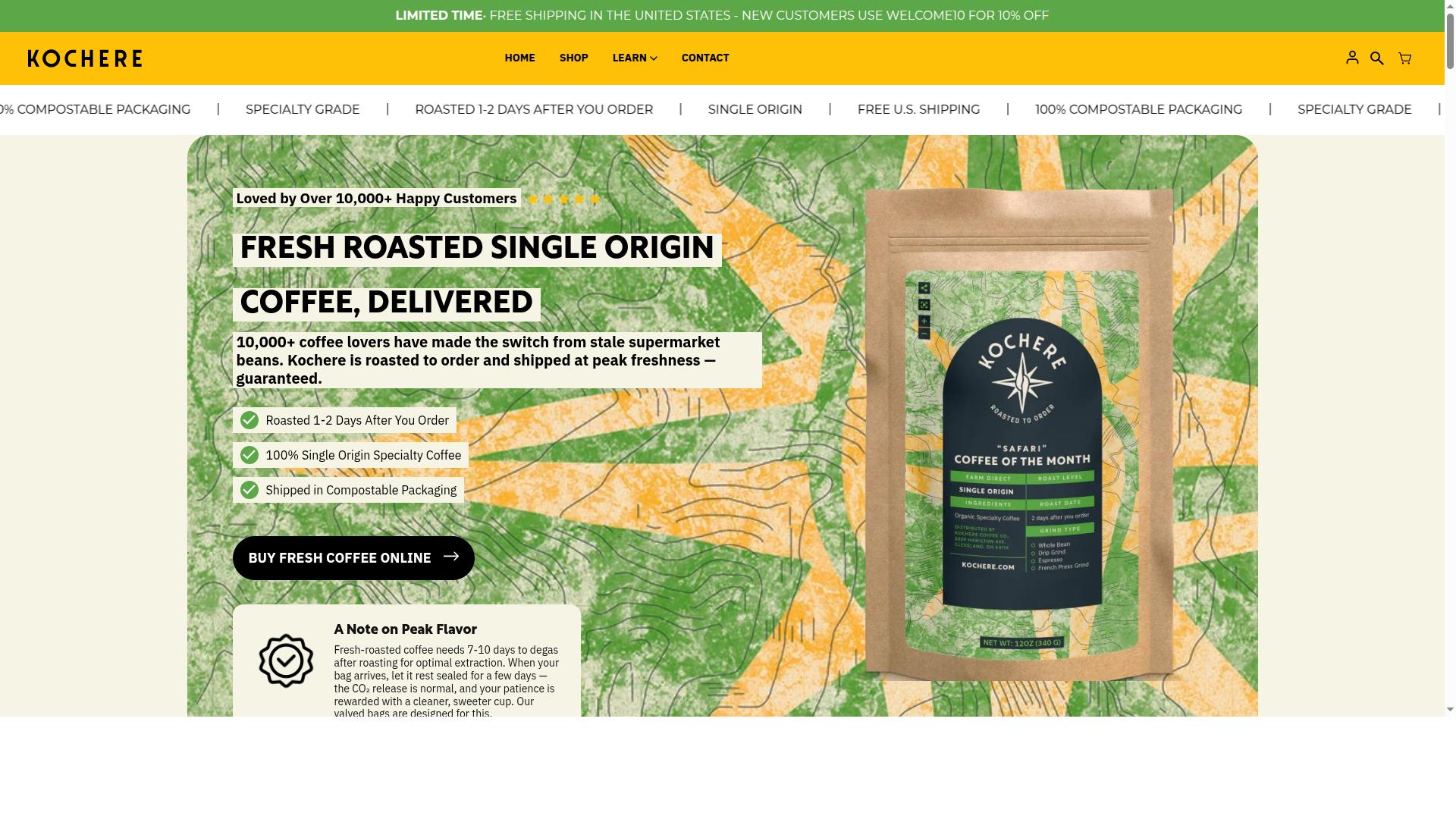
Kochere Coffee is a roast-to-order specialty coffee company that roasts every bag only after you order it, so nothing sits on a shelf. That single choice shapes everything about the coffee you pour. Instead of opening a bag that was roasted weeks ago, you open one that left the roaster the same day it shipped.
The name comes from the Kochere district in Ethiopia's Gedeo zone, one of the most celebrated coffee-growing areas in the world. It is pronounced "Koh-Chuh-Ray." The team chose that name out of respect for the place, not as a marketing shortcut. Kochere does not grow its own coffee and does not sell a Kochere-region lot.
What the company does sell is single-origin, specialty-grade Arabica sourced farm direct from smallholder cooperatives. Kochere works with growers across eight regions in Africa and the Americas: Ethiopia, Kenya, Tanzania, Uganda, Colombia, Brazil, Costa Rica and Honduras. No middlemen sit between the farm and your cup.
Every lot is hand-selected, cupped and scored by certified Q Graders. Coffees must reach 80 or above on the SCA scale to earn a place in the lineup. That score is a quality floor, and it means the bag you open has already passed a trained palate before it reaches yours.
Ordering is simple. You choose your coffee, your bag size and your grind: whole bean, drip, coarse or fine. The coffee then ships in 100% compostable packaging, a small detail that fits the company's wider focus on ethical sourcing and sustainable methods.
This article focuses on one coffee in that lineup: Ethiopian Sidamo. It is a fitting place to start, since Ethiopia is where coffee began and where the flavors in this cup were born. From here, the guide walks through Sidamo's tasting notes, how the beans are processed and how to brew them at home.
Ethiopian Sidamo Coffee: What Makes This Origin Distinct
Ethiopian Sidamo coffee comes from the Sidama Zone in southern Ethiopia, a region where coffee grows wild in the shade of native trees and has been cultivated for generations. It is one of the great names in East Africa, standing alongside Yirgacheffe, Guji and Harrar as a benchmark for what Arabica can taste like.
What sets Sidamo apart is a combination of heirloom varieties and a long tradition of natural processing, where whole cherries dry in the sun. The result is a single-origin coffee with layered fruit, floral lift and a sweetness that feels almost like preserves.
In the cup, that translates to a complex flavor profile: jasmine and bergamot up front, blueberry and stone fruit underneath, and a clean finish that keeps you coming back for the next sip. It is a coffee that rewards attention, whether you brew it as a pour-over or a simple drip.
Where Sidamo Coffee Grows: The Sidama Zone and Heirloom Cultivars
The Sidama Zone sits at elevations between 1,500 and 2,200 meters, where cool temperatures and rich volcanic soil give Sidamo coffee its distinctive character. Those high altitudes slow cherry ripening, which lets sugars and acids develop more fully inside the fruit.
Soils here are volcanic and well drained, and the climate shifts between warm days and cool nights. That swing is part of why Sidamo beans carry both bright acidity and a rounded medium body. Farmers often work small plots, many of them shaded by native trees that shelter the coffee from harsh sun.
The varieties themselves are the other half of the story. Sidamo is planted with Ethiopian landrace types, often called heirloom varieties, which are wild and semi-wild selections rather than a single named cultivar. Ethiopia holds thousands of these distinct types, and they are not widely grown outside the country.
Because so many landraces grow side by side, a single lot can carry flavors from several plant types at once. That is what gives Sidamo its complex flavor: floral aroma, citrus and berry notes, and a black tea finish that shifts as the cup cools. No two harvests taste exactly alike, and that variety is part of the appeal.
Sidamo Tasting Notes: Milk Chocolate, Caramel and Fruit
A well-roasted Ethiopian Sidamo typically offers a balanced cup with milk chocolate and caramel sweetness, layered with fruit notes like blueberry or peach and a hint of floral jasmine. The chocolate and caramel give it a soft, rounded base.
Fruit and flowers sit on top of that sweetness. Depending on the lot, you may catch stone fruit, berry or a bright citrus lift, all wrapped in a gentle jasmine aroma when the bag first opens.
That balance is what makes Sidamo so easy to love. It is complex without being sharp, sweet without being simple, and it rewards a slow first sip.
How the Natural Process Shapes Sidamo's Flavor
In the natural process, coffee cherries are spread on raised drying beds in the sun, where the fruit ferments around the bean and deepens the cup's fruitiness and body. This is the old, patient way of doing things, and Sidama Zone farmers have refined it over generations.
The steps are simple to describe and demanding to get right:
- Cherry selection: only ripe, red cherries are picked, often by hand, so the fruit that stays on the bean is at its sweetest.
- Drying beds: the cherries are spread in thin layers on raised mesh beds so air moves underneath and around every fruit.
- Turning: workers rake the cherries several times a day so they dry evenly and do not mold or over-ferment in one spot.
- Fermentation and drying: over days to weeks, the fruit sugars and yeasts work into the bean while moisture slowly drops, then the dried cherry is rested and later hulled off to reveal the green coffee inside.
All that time with the fruit attached leaves its mark. You get the winey acidity and jammy fruit depth that natural Sidamo is known for, plus a heavier, silkier body than you might expect from an Ethiopian Arabica.
Washed processing takes a different road. There, the fruit is removed soon after picking and the bean is rinsed and fermented clean before drying, which tends to produce a lighter body and a clearer, tea-like cup. Both methods have their fans, and both can be excellent. Natural processing simply leans harder into fruit and sweetness, and that is exactly the character Sidamo drinkers come back for.
The heirloom varieties grown across Ethiopia's highlands add their own layer. Small farms at altitude ripen slowly, and that slow ripening helps concentrate the sugars that fermentation later turns into flavor. When you brew a natural Sidamo, you are tasting landrace genetics, mountain air and careful handwork in the same cup.
How to Brew Ethiopian Sidamo Coffee
Brewing Ethiopian Sidamo coffee well starts with a good ratio and the right grind, whether you use a pour over, French press, or drip machine. The delicate florals and citrus notes in a washed Sidamo are easy to drown out with too much coffee or water that is too hot.
Give this single-origin coffee a little attention and it rewards you. A light roast Sidamo opens up with jasmine and bergamot on the nose, then a clean, tea-like finish in the cup. A medium roast leans toward honey sweetness and stone fruit.
Freshness matters just as much as technique. Coffee roasted to order and ground just before brewing holds onto those fragile aromatics far better than a bag that has sat on a shelf. The methods below each pull something different out of the bean, so try a couple and see which one suits your taste.
Pour Over, French Press and Drip: Ratios and Grind Tips
For pour over, start with a 1:16 coffee-to-water ratio, a medium-fine grind, and water just off the boil at about 200°F (93°C). This method gives you the most control, and it is the clearest window into Sidamo's bright citric acidity and floral aroma.
Here is the basic sequence:
- Rinse the filter with hot water, then add your grounds and level them.
- Pour just enough water to saturate the bed, about twice the weight of the coffee, and wait 30 to 45 seconds. This is the bloom, and it lets trapped gases escape so the coffee extracts evenly.
- Pour the rest in slow circles, keeping the water level steady, and finish in about 2.5 to 3 minutes.
Expect a silky mouthfeel and a clean cup that shows off the lemon and bergamot notes. If it tastes sharp or hollow, nudge the grind slightly finer.
French press calls for a 1:15 ratio and a coarse grind, closer to sea salt than sugar. Use water around 200°F, add all the water at once, stir gently, and let it steep for about four minutes before pressing slowly.
The metal filter lets more oils and fine particles through, which builds medium body and rounds out the acidity. Blueberry and peach notes often come forward here, and the cup feels fuller and sweeter than a pour over.
For drip, use a 1:16 ratio with a medium grind and water at roughly 195°F to 200°F. A standard machine does the work for you, so the main lever is grind size. Too fine and the bed clogs, drawing out bitterness; too coarse and the cup tastes thin.
Drip tends to land in the middle, balancing floral aroma with honey sweetness. It is the easiest way to enjoy Sidamo on a busy morning. Whichever method you choose, grind just before brewing and adjust one variable at a time until the cup tastes right to you.
Kochere Coffee's Ethiopian Sidamo: Roast, Freshness and Pricing
Kochere Coffee roasts its Ethiopian Sidamo to a medium-light roast, a level that balances the bean's chocolate sweetness with its fruit and floral notes. It is a natural process coffee built on heirloom cultivars from the Sidama Zone. In the cup, expect milk chocolate, caramel and fruit to move together, with the fruit note shifting as the coffee cools.
That medium-light roast keeps the cup sweet and rounded. You get the chocolate and caramel up front, then a soft fruit finish that lingers. It is an easy coffee to love, whether you drink it black or with a splash of milk.
The Sidamo is part of a single-origin lineup that also includes Ethiopian Harrar, Tanzanian Peaberry, Kenyan Nyeri & Embu, Brazilian Santos, Colombian Medellín, Costa Rican Alajuela, Honduran Marcala and Ugandan Sipi Falls. Each bag is available as whole bean or in coarse, drip or fine grind.
Freshness is the heart of how Kochere Coffee works. Your Ethiopian Sidamo is roasted after you order and ships the same day. That means the bag that lands on your counter was roasted days ago, not months ago.
You will notice it the moment you open the bag. Natural process Sidama coffees tend to release a sweet, fruity aroma right away, and that is the signal of a recent roast. Grind just before brewing and those chocolate and caramel notes come through even more clearly.
Ordering is simple. Pick your size, pick your grind, and the Kochere team roasts to fill it. If the coffee does not land right for you, the Perfect Cup Guarantee covers you: not happy within 30 days, and you get a replacement or a full refund, with no return shipping.
Pricing is straightforward, and the larger bags bring the cost per cup down. Here is how the Ethiopian Sidamo is sold:
| Size | Price |
|---|---|
| 12 oz | $26.99 to $27.99 (most single origins $27.49) |
| 1 lb | $33.99 to $35.99 |
| 2 lb | $59.99 to $62.99 |
| 5 lb | $99.99 |
Shipping is free in the continental US. If you drink a daily cup, the 1 lb or 2 lb bag is a sensible step up, and the 5 lb suits a household or an office that goes through coffee quickly.
For a coffee roasted only after you order it, that pricing sits comfortably in the single-origin range. You are paying for a fresh roast and a traceable Sidama lot, not a bag that sat on a shelf. That is the deal Kochere Coffee offers with its Ethiopian Sidamo, and it is a good one.
Trust Signals: Q Graders, SCA Scoring and Customer Reviews
Every lot Kochere Coffee offers is cupped and scored by certified Q Graders using the SCA scoring protocol, and only coffees scoring 80 or above make it into the lineup. That single rule tells you a lot about what lands in your grinder.
A Q Grader is a licensed coffee taster who has passed a demanding set of sensory exams. They evaluate aroma, flavor, acidity, body, balance, sweetness, uniformity and cleanliness in the cup, then subtract for defects.
The SCA scale runs to 100 points. Anything at 80 or above counts as specialty grade, and Kochere describes its coffees as scoring in that range, placing them in roughly the top 3% of the world's coffee.
Why does that matter for Ethiopian Sidamo coffee? Because a high score means the cup is clean and the flavors are distinct. You should taste jasmine, bergamot or lemon in a washed Sidamo, or blueberry and stone fruit in a natural, without muddiness covering them up.
Scoring also protects you across lots and harvests. A number on a cupping table is a shared language, so a floral, citric profile you loved last season has a benchmark behind it rather than a vague promise.
Customer feedback adds the human side to those numbers. One recurring theme in reviews of the Ethiopian Harrar is how clearly the cup delivers its character, with drinkers noting the winey fruit and rich aroma they hoped for when the bag first opened.
That kind of comment is the everyday version of a cupping score. A grader writes down "berry, cocoa, bright acidity." A customer writes, "this is exactly the cup I wanted." Both point at the same thing: flavor you can count on.
If a coffee ever misses for you, the Perfect Cup Guarantee covers it. Not happy within 30 days, and you get a replacement or a full refund, with no return shipping to deal with.
Put it together and the trust story is simple. Certified Q Graders cup each lot, the SCA protocol sets the bar at 80 and above, and the coffees that clear it are the ones roasted to order for you.
For a Sidamo, Yirgacheffe or Guji in your cart, that means the delicate floral and citrus notes you read about have been tasted and verified before the green coffee ever reached the roaster.
Who Should Buy Kochere Coffee's Ethiopian Sidamo
Kochere Coffee's Ethiopian Sidamo is a great fit for home coffee lovers who want a single-origin coffee with a balance of chocolate sweetness and fruit, and who value freshness above all. If the bag you open smells like jasmine and citrus before you even grind, that is the point. This is coffee roasted to order, not coffee that has been waiting on a shelf.
That makes it a natural pick for anyone who brews at home and has grown tired of stale supermarket beans. Pour over, French press, drip, or espresso: the coffee meets you wherever your setup already lives. You do not need new gear to enjoy it, just a grinder and a few minutes.
The flavor profile is friendly to both ends of the experience spectrum. If you are just starting your single-origin coffee journey, the chocolate sweetness gives you something familiar to hold onto while the fruit notes open up. If you have been drinking African coffees for years, the clean cup and bright acidity give you plenty to pay attention to.
Curious drinkers who want to explore the world's origins one bag at a time will find Sidamo a rewarding stop. It sits in Ethiopia, the birthplace of Arabica, and the heirloom varieties behind it carry a story worth knowing. Kochere's roast-to-order approach keeps that story intact in the cup.
Gift buyers have a strong option here too. A fresh-roasted single-origin bag is a thoughtful present for a coffee lover, especially one who already grinds at home. Pair it with the story of the Sidama Zone and you have given more than beans.
Finally, if you care about where your coffee comes from and how it was sourced, this is a roaster built for that curiosity. The Kochere team treats origin as something to celebrate, not a marketing line. Freshness, origin, and sourcing are the reasons to choose this bag.
Final Verdict: Is Kochere Coffee's Sidamo Worth It?
If you value coffee that arrives fresh-roasted and full of the complex flavors Ethiopian Sidamo is known for, Kochere Coffee's offering is worth trying. It brings together a distinct origin, a natural process, and a medium-light roast that lets the cup's fruit and floral notes speak clearly.
Here is what makes it stand out, in plain terms:
- Distinct origin: Sidamo, in Ethiopia's Sidama Zone, is one of East Africa's storied growing regions, and this single-origin coffee carries that character from the first sip.
- Natural processing: The beans are sun-dried with the cherry still on, a method that often layers in blueberry, stone fruit, and honey sweetness.
- Medium-light roast: Balanced enough to keep the floral aroma and bright acidity intact while rounding out the body.
- Roast-to-order freshness: Your bag is roasted when you order, so the jasmine and bergamot notes hit the moment you open it.
- Q Grader quality checks: Licensed Q Graders assess the coffee, giving you a reliable baseline for a clean, well-developed cup.
Where does it fit best? If you love a complex flavor profile with citrus and black tea notes, this Sidamo rewards a careful brew. If you prefer a heavy, dark-roast cup, a medium-light roast like this may feel brighter than you expect. That is not a flaw, just a different kind of pleasure.
On balance, the verdict is clear: this is a coffee for drinkers who put freshness and single-origin character first. The natural process and medium-light roast work together to show what Sidama Zone coffee can do. The Perfect Cup Guarantee backs it too: if you are not happy within 30 days, you get a replacement or a full refund, with no return shipping.
For more details or to order, visit kochere.com or email support@kochere.com. You can also follow Kochere Coffee on Instagram, TikTok, X, Facebook, and Pinterest at @kocherecoffee. Pour a cup, take your time with the aroma, and let the first sip tell you the rest.
Frequently Asked Questions
What does Ethiopian Sidamo coffee taste like?
Kochere Coffee's Ethiopian Sidamo is a natural-process, medium-roast single origin with the berry-forward, floral and gently sweet character Sidamo is known for. Because it's roasted to order, the cup arrives at peak freshness, so you're tasting the coffee rather than the warehouse. Brew it as a pour over to tease out the fruit and aromatics.
How is Kochere Coffee's Ethiopian Sidamo processed?
Our Ethiopian Sidamo is a natural-process coffee, meaning the whole cherry is dried around the bean, which is what builds those fruity, berry-led notes. It's a single origin from Ethiopia, roasted to order in small batches. Every lot is cupped and scored by certified Q Graders before it joins the lineup.
What's the best way to brew Ethiopian Sidamo?
Sidamo's bright, fruity profile shines with pour over, which lets you control the brew and highlight the aromatics; a French press works well if you prefer a fuller body. Use freshly roasted beans, grind just before brewing, and start with a medium-fine grind for pour over, adjusting to taste. Kochere Coffee ships each bag the same day it's roasted, so you're brewing at peak freshness.
How fresh is Kochere Coffee when it arrives?
Every bag is roasted only after you order it - nothing sits on a shelf - and it ships the same day it's roasted. That means your Sidamo reaches you at peak freshness rather than after weeks in a warehouse. It's one of the reasons home brewers who care about origin and freshness choose Kochere Coffee.
How much does Kochere Coffee's Ethiopian Sidamo cost?
Single origins like Ethiopian Sidamo are priced at $26.99-$27.99 for a 12 oz bag (most single origins are $27.49), with 1 lb bags at $33.99-$35.99, 2 lb at $59.99-$62.99 and 5 lb at $99.99. Shipping is free across the continental United States. You can also explore more origins with the Single Origin Sampler at $29.99.
What if I don't love my coffee?
Kochere Coffee backs every order with the Perfect Cup Guarantee: if you're not happy within 30 days, you get a replacement or a full refund, with no return shipping. Just reach out to support@kochere.com and the Kochere team will take care of it. It's a risk-free way to try Ethiopian Sidamo for yourself.