What Is the Wolverine Peptide Stack? BPC-157 and TB-500 Explained for Researchers
BPC-157 and TB-500 are often ordered together, yet few researchers can explain what each compound actually does. Pairing them in one protocol means tracking two mechanisms, two reconstitution schedules, and two sets of handling requirements. Getting any of those wrong wastes a batch.
This article defines the Wolverine stack, breaks down each peptide's mechanism and research context, and explains why the two are studied together. You will also learn how Kovagen's 10/10 formulation is batch tested and what the research-use-only status means for your lab.
What Is the Wolverine Peptide Stack? BPC-157 and TB-500 Defined
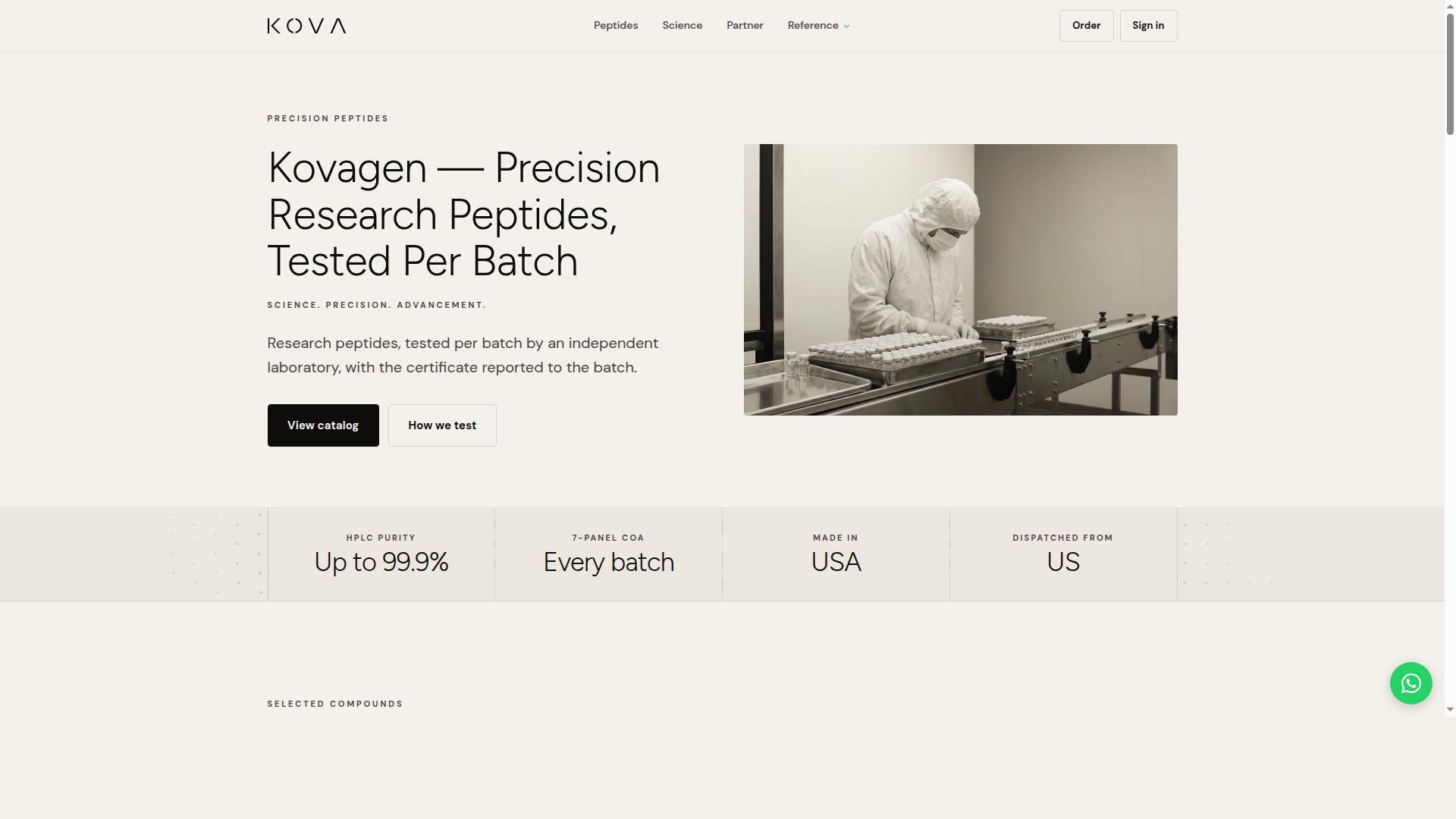
The Wolverine Peptide Stack is a research combination of two synthetic peptides, BPC-157 and TB-500, that investigators pair to study complementary pathways in tissue repair and cellular dynamics. It is typically supplied as a lyophilized powder in a single vial, which allows laboratories to reconstitute and dose both compounds together.
BPC-157 is a synthetic pentadecapeptide, sometimes called a body protection compound or gastric pentadecapeptide, derived from a sequence found in gastric juice. TB-500 is a synthetic fragment related to thymosin beta-4 (TB4), a protein studied for its role in actin regulation.
The term "Wolverine" is a colloquial market name, not a scientific or chemical designation. No peer-reviewed literature uses it to describe a defined compound. It simply labels the pairing of these two research peptides.
Both compounds are intended for laboratory research use only. They are not approved drugs, and nothing in this article should be read as guidance for human or veterinary use. The sections below cover the rationale for pairing them, the naming conventions in the supply market, their distinct mechanisms, handling considerations, and how a specific supplier presents the blend.
Why Researchers Pair BPC-157 and TB-500
Researchers pair BPC-157 and TB-500 because their studied mechanisms converge on extracellular matrix remodeling and cell migration, yet act through distinct molecular routes. This difference is what makes the combination interesting as a research subject.
BPC-157 has been examined in models of angiogenesis, with research linking it to VEGF and eNOS pathways and to nitric oxide signaling. These pathways influence vessel formation and blood flow, which matter in early wound healing research.
TB-500, as a thymosin beta-4 fragment, is studied for actin regulation, specifically the balance between G-actin and F-actin. This cytoskeletal dynamics work is tied to cell migration and matrix organization in regenerative research models.
The pairing hypothesis is that studying both compounds together allows investigators to examine an early vascular response alongside later matrix organization. Framed this way, the blend supports tissue repair research across complementary phases rather than a single pathway.
It is important to note that synergy is a hypothesis, not an established fact. Research suggests overlap in wound healing and regenerative models, but controlled studies comparing the blend to each peptide alone remain limited. Blends are supplied as single vials so laboratories can maintain controlled dosing and consistent ratios during experiments.
What "Wolverine" Refers to in the Research Supply Market
In the research supply market, "Wolverine" is a trade nickname for a pre-mixed BPC-157 and TB-500 blend, typically offered in a 10mg/10mg ratio per vial. It is a labeling convention, not a chemical identifier, and it carries no standardized definition across suppliers.
Because ratios and vial sizes vary by supplier, researchers should verify the exact composition before ordering. A certificate of analysis (CoA) showing batch-tested purity is the most reliable way to confirm what a vial actually contains.
The nickname often appears alongside terms like "peptide stack" or "peptide blend" in product listings. These phrases describe the format, not the science. Regardless of the label used, the active compounds remain BPC-157 and TB-500.
Purity testing matters because a blend combines two compounds in one vial. Batch testing, typically by high-performance liquid chromatography and mass spectrometry, confirms identity and purity for each component. Researchers should request batch-specific documentation rather than relying on a generic product description.
When evaluating a supplier's Wolverine offering, look for a stated ratio, vial size, and a CoA tied to the specific lot. These details let laboratories confirm the material matches their experimental design before any work begins.
BPC-157: Mechanism and Research Context
BPC-157 is a synthetic pentadecapeptide (15 amino acids) derived from a sequence found in human gastric juice, studied for its effects on angiogenesis and fibroblast activity in preclinical models. In the literature it is often called the "body protection compound" or gastric pentadecapeptide, reflecting its origin and the protective roles researchers have explored.
Within the Wolverine Peptide Stack, BPC-157 is one half of a two-peptide combination. The other half, TB-500, is a thymosin beta-4 fragment. Researchers typically examine each compound's mechanism separately before considering how a peptide blend might behave together.
As a small synthetic peptide, BPC-157 is valued in research settings for its relatively short sequence and straightforward handling compared with larger proteins. Its stability in laboratory preparations is a frequent topic in method sections, since peptide integrity affects reproducibility across experiments.
Most published work on BPC-157 is preclinical, using cell cultures and animal models. Findings should be read as early-stage observations rather than established clinical outcomes. The compound is supplied for research use only.
Common research contexts for BPC-157 include:
- Wound healing research, where investigators observe closure rates in controlled models
- Tissue repair research across muscle, tendon, and other connective tissues
- Gastrointestinal models, given the peptide's gastric juice origin
These areas overlap with the broader regenerative research themes that connect BPC-157 to TB-500 in the Wolverine Peptide Stack.
Several mechanisms are studied in relation to BPC-157. A central one is upregulation of VEGF (vascular endothelial growth factor) and eNOS, which supports angiogenesis, the formation of new blood vessels. Nitric oxide modulation is also examined as part of this vascular pathway.
On the tissue side, research describes promotion of fibroblast proliferation and collagen synthesis. Together these processes are linked to extracellular matrix remodeling, the structural reorganization that accompanies tissue repair research.
These mechanisms are typically studied in isolation or in small combinations. Researchers should treat each pathway as a working model, not a confirmed clinical mechanism.
BPC-157 appears alongside TB-500 in the Wolverine Peptide Stack because the two are often discussed together in regenerative research circles. TB-500's actin regulation, involving G-actin and F-actin cytoskeletal dynamics, addresses cell migration from a different angle than BPC-157's angiogenic focus.
Whether the peptide combination produces additive or interactive effects is a question for controlled study. Existing literature does not settle it, and researchers should design experiments that isolate variables where possible.
For laboratory work, BPC-157 is handled as a research peptide with standard precautions: careful storage, accurate reconstitution records, and clear labeling. Documentation of peptide source and purity supports reproducibility in tissue repair research and wound healing research alike.
The key takeaway is that BPC-157 is a well-studied preclinical pentadecapeptide with plausible angiogenic and matrix-remodeling mechanisms. All findings remain research-use-only, and no human dosing or medical claims should be drawn from them.
TB-500 (Thymosin Beta-4): Mechanism and Research Context
TB-500 is a synthetic fragment of thymosin beta-4 (TB4), a naturally occurring protein studied for its role in actin regulation and cell migration during tissue repair. In the Wolverine Peptide Stack, it is paired with BPC-157 as a peptide combination that researchers examine across overlapping pathways of regenerative research. TB-500 is not the full TB4 protein. It corresponds to the active region of the parent molecule, which is why it is often described as a thymosin beta 4 fragment rather than a complete replacement.
Suppliers typically provide TB-500 as a lyophilized powder, a freeze-dried format intended for reconstitution and controlled laboratory handling. This presentation supports stability during storage and shipping, and it is standard for many research peptides. Researchers should confirm identity and purity documentation before use, since fragment length and sequence fidelity matter when comparing results across batches.
The most frequently studied mechanism for TB4 and its fragments is actin regulation. TB4 binds G-actin, the monomeric form of the protein, and helps sequester it in a way that influences the balance between G-actin and F-actin polymers. This interaction shapes cytoskeletal dynamics, the structural rearrangements cells rely on when they move, divide, or reorganize during repair.
Because actin turnover sits at the center of cell motility, changes in G-actin sequestration can influence how readily cells migrate into a wound site. In preclinical models, this has made TB4 fragments a focus of cell migration and tissue repair research. The proposed link is mechanistic rather than established: actin binding is observed, and downstream effects on movement are studied, but the full causal chain remains an active area of investigation.
Alongside actin binding, TB4 fragments have been examined for their role in angiogenesis, the formation of new blood vessels that supply repairing tissue. Research suggests this may involve VEGF, or vascular endothelial growth factor, as well as nitric oxide signaling through eNOS. New vessel formation is relevant to wound healing research because repair depends on adequate blood supply to the injured area.
Preclinical work also points toward effects on fibroblast proliferation and collagen synthesis, two processes tied to rebuilding the extracellular matrix. Together, these pathways form the rationale for studying TB-500 in regenerative research. It is important to note that these findings come from laboratory and animal models, not from controlled human trials, and they should be read as mechanistic leads rather than confirmed outcomes.
A related fragment, Ac-SDKP, is often cited as a research reference point. It is a short tetrapeptide derived from the TB4 sequence and has been studied independently for its own biological activity. Comparing Ac-SDKP with TB-500 helps researchers distinguish effects tied to the larger active region from those carried by a minimal sequence.
This distinction matters when interpreting the literature. Findings attributed to TB4 as a whole may not transfer directly to a fragment, and results from one fragment may not apply to another. Researchers working with the Wolverine Peptide Stack should track which molecule, sequence, and model each study used. That context is essential for meaningful comparison across peptide research.
TB-500 research is preclinical. The published work centers on cell culture and animal models, and it does not establish safety or efficacy for human use. Nothing in this overview should be read as a human use implication or as guidance for dosing, administration, or therapeutic application.
For laboratory study, the practical points are straightforward:
- Confirm the material is the fragment, not full-length TB4
- Review purity and identity documentation from the supplier
- Store lyophilized powder per the supplier's stated conditions
- Compare results only against studies using a matching sequence and model
Handled with that rigor, TB-500 serves as a defined synthetic peptide tool for probing actin regulation, cell migration, and angiogenesis in controlled settings.
How the Two Compounds Differ - and Why the Stack Is Studied Together
BPC-157 and TB-500 differ in origin, sequence, and primary mechanism, yet their studied pathways intersect at extracellular matrix remodeling and cell migration. Understanding those differences is essential before treating the Wolverine Peptide Stack as a single research tool rather than two distinct compounds.
BPC-157 is a gastric pentadecapeptide, a short synthetic peptide of fifteen amino acids derived from a sequence found in human gastric juice. Its research profile centers on angiogenesis and fibroblast activity, with studies examining VEGF signaling, eNOS and nitric oxide pathways, and collagen synthesis in tissue repair models.
TB-500 is a thymosin beta-4 fragment, specifically the actin-binding region of the larger TB4 protein. Its studied mechanism is entirely different. TB-500 interacts with G-actin and actin regulation, influencing cytoskeletal dynamics and cell migration rather than vessel formation or matrix deposition.
The table below summarizes the core contrasts researchers typically track when designing peptide combination work.
| Feature | BPC-157 | TB-500 |
|---|---|---|
| Class | Gastric pentadecapeptide | Thymosin beta-4 fragment |
| Size | 15 amino acids | Short TB4-derived fragment |
| Primary focus | Angiogenesis, fibroblast proliferation | Actin regulation, cell migration |
| Key pathways | VEGF, eNOS, nitric oxide | G-actin to F-actin dynamics |
| Matrix role | Collagen synthesis, matrix deposition | Cytoskeletal remodeling, cell recruitment |
Researchers combine the two to study what appear to be complementary phases of repair. One phase involves vascularization and matrix deposition, while the other involves cytoskeletal dynamics and cell recruitment. Studying them together lets labs examine whether these processes interact across a single experimental timeline.
The stack also allows simultaneous administration in controlled laboratory settings, which simplifies protocol design when investigators want to compare combined exposure against either compound alone. This is a practical convenience for peptide research, not evidence of synergy.
It is important to stress that combination studies remain preclinical. No human trials establish clinical synergy for this peptide blend, and findings from cell and animal models should not be translated into therapeutic claims. The Wolverine Peptide Stack is a research construct, and regenerative research using it should be framed with that limitation in mind.
Handling, Reconstitution, and Storage Considerations for Lab Use
Proper handling of lyophilized BPC-157 and TB-500 begins with storage at -20°C, reconstitution with bacteriostatic water, and gentle mixing to avoid peptide degradation. Small procedural errors at any of these steps can compromise a synthetic peptide before it ever reaches a study protocol.
This section covers the practical bench steps for the Wolverine Peptide Stack, from cold storage through reconstitution and short-term holding. Exact parameters always depend on study design and institutional rules.
Lyophilized vials should stay at -20°C for long-term storage. Keep them protected from light, since both the gastric pentadecapeptide BPC 157 and the thymosin beta-4 fragment TB-500 are sensitive to photodegradation over time.
Before opening a vial, let it equilibrate to room temperature. This step prevents condensation from forming inside the vial and introducing moisture to the powder. Wipe the septum with an appropriate disinfectant before every entry.
For reconstitution, use bacteriostatic water or sterile saline as the solvent. Add the liquid slowly down the vial wall rather than directing a stream onto the powder.
Swirl gently to dissolve. Do not vortex or shake, because mechanical shear can disrupt peptide structure and promote aggregation. A typical working concentration falls between 1 and 5 mg/mL, though the exact figure should follow your study design.
After reconstitution, store the solution at 2 to 8°C for short-term use. Avoid repeated freeze-thaw cycles, which stress the peptide and can reduce integrity across a study.
If aliquoting is part of your protocol, divide the solution into single-use portions before freezing. This limits handling and keeps each aliquot consistent for regenerative research and tissue repair research applications.
All handling should follow institutional biosafety and research-use-only protocols. Document storage dates, solvent lot, and concentration for traceability. Research peptides are intended for laboratory investigation, not human or veterinary use.
Consistent technique across the peptide combination supports reproducible results in wound healing research, angiogenesis assays, and cytoskeletal dynamics studies involving actin regulation.
Kovagen (KOVA)'s Wolverine (BPC-157 / TB-500) 10/10: Specs, Testing, and Pricing
Kovagen (KOVA) supplies its Wolverine (BPC-157 / TB-500) 10/10 as a lyophilized powder blend containing 10mg of each peptide per vial, priced at $140.00. The format gives researchers both compounds in a single vial, which suits study designs that examine the two peptides together rather than in isolation.
BPC-157 is a synthetic pentadecapeptide, sometimes called body protection compound, studied in regenerative research contexts. TB-500 is a thymosin beta-4 fragment, and both compounds appear in tissue repair research and wound healing research models. A fixed-ratio blend keeps the pairing consistent from vial to vial.
Kovagen sells stocked research peptides and research supplies, and this blend sits within a catalog of 30 compounds, made up of 22 single peptides and blends. For pricing context, BPC-157 10mg is listed at $80.00 and TB-500 10mg at $85.00, so the combined vial is priced close to the sum of its parts rather than at a premium.
All products are supplied for research use only. Kovagen states that it does not provide dosing, administration, or reconstitution guidance, and the catalog is intended for laboratory professionals rather than any other use.
Batch Testing, COA Access, and Shipping for Researchers
Kovagen publishes a certificate of analysis for every batch, retrievable by batch number without an account, and ships U.S. orders via FedEx 2Day with next-business-day dispatch. Testing is handled by an independent analytical laboratory, not in-house, which keeps verification separate from production.
Each batch carries a 7-panel COA, and HPLC purity is listed at up to 99.9%. Because certificates are tied to specific batches, a researcher can match the documentation to the exact vial in hand. Questions about a COA or a shipment can go to contact@kovagen.com.
Shipping details are straightforward:
- Kovagen ships to the United States and Canada only.
- U.S. orders use FedEx 2Day, dispatched by the next business day.
- Shipments travel at ambient temperature.
- Shipping is free on orders of $250 or more after discounts; below that, the charge is $18.
Products are made in the USA and dispatched from the US. Kovagen also runs a partner program: 25% on a referred new customer's first eligible order, then 10% on eligible repeat orders for life. Combined with per-batch COAs and clear dispatch timing, the setup gives research labs a documented, traceable source for the Wolverine Peptide Stack.
Who the Wolverine Stack Is For - and Its Research-Use-Only Status
The Wolverine Stack is intended strictly for laboratory researchers studying tissue repair and cellular dynamics, and all materials are supplied for research use only-not for human or veterinary consumption. This is not a wellness product, a recovery aid, or a supplement for athletes. It is a peptide combination built for controlled preclinical work, and that framing should guide every decision about whether it belongs in your lab.
At Kovagen, all materials are supplied for laboratory research use only. That means every vial is positioned for bench science, not for personal or clinical application. Researchers should read that status as a hard boundary, not a formality. Research-use-only designations exist to keep experimental compounds inside environments where they can be handled, observed, and documented properly.
The Wolverine Peptide Stack pairs BPC-157, a gastric pentadecapeptide and synthetic peptide often called body protection compound, with TB-500, a thymosin beta-4 fragment. Both are studied in regenerative research, tissue repair research, and wound healing research models. Neither is approved for diagnostic or therapeutic use, and neither should be described that way in a lab notebook or a grant summary.
Understanding the intended audience helps clarify why this stack is framed so tightly. The relevant questions are about cell migration, fibroblast proliferation, collagen synthesis, and extracellular matrix remodeling, not about outcomes for any individual. A researcher approaching the Wolverine Stack should already be comfortable with those concepts and with the analytical methods used to measure them.
Appropriate users typically share three characteristics:
- Institutional oversight, meaning the work sits under an ethics committee, biosafety officer, or equivalent review body.
- Proper training in handling lyophilized peptides, reconstitution technique, and storage conditions.
- Biosafety protocols covering personal protective equipment, waste disposal, and documentation of chain of custody.
If any of those elements are missing, the material is not appropriate for that setting, regardless of intent. Kovagen supplies these materials explicitly for laboratory research, and the expectation is that buyers already operate within a compliant framework.
Before ordering, researchers should verify institutional compliance with their own procurement and safety policies. Some institutions require additional approval for compounds with a research-use-only label. Others restrict who may place an order or where materials can be stored. Confirming those details in advance avoids delays and keeps the purchase aligned with the lab's own rules.
It is also worth stating plainly what this section does not cover. There is no discussion of personal use, no dosing guidance, and no suggestion that the Wolverine Stack has any application outside a research context. Any content elsewhere that implies otherwise should be treated with caution. The research-use-only status is the defining feature here, and it is the reason Kovagen frames the product the way it does.
The clear verdict for researchers: the Wolverine Stack is a legitimate laboratory tool from Kovagen when it is used as intended, by trained personnel, under institutional oversight, and with full respect for its research-only designation. Used outside that frame, it is neither appropriate nor supported.
Final Verdict: Is the Wolverine Peptide Stack Worth Investigating?
The Wolverine Peptide Stack is worth investigating for preclinical research on complementary repair pathways, provided researchers source batch-tested material and adhere to research-use-only protocols. The combination pairs two distinct mechanisms in one study design, which is exactly what makes it a rational subject for regenerative research rather than a redundant blend.
BPC-157, a gastric pentadecapeptide, is studied for its influence on angiogenesis, VEGF signaling, eNOS and nitric oxide pathways, and fibroblast activity. TB-500, a thymosin beta-4 fragment, is examined for actin regulation, G-actin and F-actin binding, cell migration, and extracellular matrix remodeling.
Because one compound leans toward vascular and cytoprotective signaling while the other centers on cytoskeletal dynamics and cell movement, the pair covers complementary ground in tissue repair research and wound healing research. That mechanistic separation, not overlap, is the core argument for studying them together.
Key takeaways for researchers weighing this stack:
- The stack combines BPC-157 and TB-500 for studying angiogenesis, cell migration, and matrix remodeling.
- Differences in mechanism make the pair a rational research subject, since each peptide informs a different pathway.
- Independent batch testing and COA verification are non-negotiable for any synthetic peptide work.
- All materials remain for laboratory research use only, with no human or veterinary application implied.
Sourcing quality deserves the same scrutiny as study design. A certificate of analysis tied to a specific batch number is the only reliable way to confirm identity and purity for a given vial, and researchers should verify that documentation before committing material to a protocol.
For sourcing, Kovagen (KOVA) offers the Wolverine 10/10 at $140.00, with per-batch independent lab testing and COAs retrievable by batch number. That batch-level traceability supports the verification step described above.
Researchers can reach the team by email at contact@kovagen.com, with a response within one business day. WhatsApp is available at +1 619 335 7514, and the postal address is Hybrid Tech Rainbows LLC, 30 N Gould St, STE R, Sheridan, WY 82801, United States.
All materials discussed are for laboratory research use only. The evidence base for this peptide combination remains preclinical, so conclusions should be framed accordingly.
Frequently Asked Questions
What exactly is the Wolverine peptide stack?
The Wolverine stack is a research blend combining BPC-157 and TB-500 (Thymosin Beta-4), two peptides commonly studied together in laboratory settings. Kovagen supplies this blend as a lyophilized powder, with the Wolverine (BPC-157 / TB-500) 10/10 format listed at $140.00. As with all Kovagen products, it is supplied strictly for laboratory research use only.
How is the Kovagen Wolverine stack tested for quality?
Every batch is tested by an independent analytical laboratory rather than in-house, with certificates of analysis published per batch and retrievable by batch number without an account. Kovagen reports HPLC purity up to 99.9% and provides a 7-panel COA for each batch. This per-batch testing approach is central to Kovagen's positioning: "Precision Research Peptides, Tested Per Batch."
Can I buy BPC-157 or TB-500 individually instead of the blend?
Yes. Kovagen stocks both compounds as single peptides alongside the combined Wolverine blend. BPC-157 10mg is listed at $80.00 and TB-500 Thymosin Beta-4 (Long Chain) 10mg at $85.00, so researchers can choose single compounds or the blend depending on their study design.
Where does Kovagen ship, and how fast?
Kovagen ships to the United States and Canada only; it cannot ship elsewhere at this time. Every U.S. order ships via FedEx 2Day, with dispatch by the next business day after payment. Prices are listed in USD.
How can I verify a batch or contact Kovagen with questions?
Certificates of analysis are tied to each batch and can be retrieved by batch number without creating an account. For additional questions, you can email contact@kovagen.com (responses within one business day) or reach the team via WhatsApp at +1 619 335 7514. Kovagen (KOVA) is operated by Hybrid Tech Rainbows LLC, Sheridan, WY.
Are Kovagen peptides intended for human use?
No. All Kovagen materials are supplied for laboratory research use only and are not for human or veterinary consumption. The Wolverine stack and other peptides are sold as lyophilized powders intended for controlled research environments, not for diagnostic or therapeutic applications.