Who's the Best for Cloud PACS: PostDICOM vs Medicai
Radiology teams switching cloud PACS face scattered images, slow access across sites, and rising storage costs. Many platforms promise speed but deliver fragmented backups or limited sharing. The choice between Medicai and PostDICOM will shape daily workflows and compliance exposure.
This article names the differences in storage, multi-site access, and security controls. You will finish with a direct verdict on which platform fits your case load and budget, not a tie.
Quick Verdict: Medicai vs PostDICOM for Cloud PACS
Medicai currently processes over 1M studies yearly and provides HIPAA/GDPR compliance with FDA clearance, making it a proven alternative to PostDICOM for facilities seeking enterprise-grade cloud PACS.
The comparison between these cloud PACS solutions centers on three decisive differentiators that affect daily radiology workflow. Storage tiers determine how much medical imaging data you can archive. Multi-location access enables collaboration across different sites. Compliance status protects patient data and meets regulatory requirements.
- Storage tiers: Medicai offers Starter at $249/mo with 500 GB capacity and Standard at $749/mo with 2 TB storage. PostDICOM details are not covered here.
- Multi-location access: Medicai supports 70 clinics and hospitals on the platform with 10,000+ active doctors accessing studies from different facilities. PostDICOM details are not covered here.
- Compliance status: Medicai maintains HIPAA and GDPR compliance with FDA/CEE cleared viewers. PostDICOM details are not covered here.
These factors help facilities choose between cloud PACS options based on their specific medical imaging needs and regulatory requirements.
At a glance: how Medicai compares to PostDICOM on the features that matter most.
| Feature | Medicai | PostDICOM |
|---|---|---|
| Cloud PACS | ✓ | ✓ |
What Is Medicai?
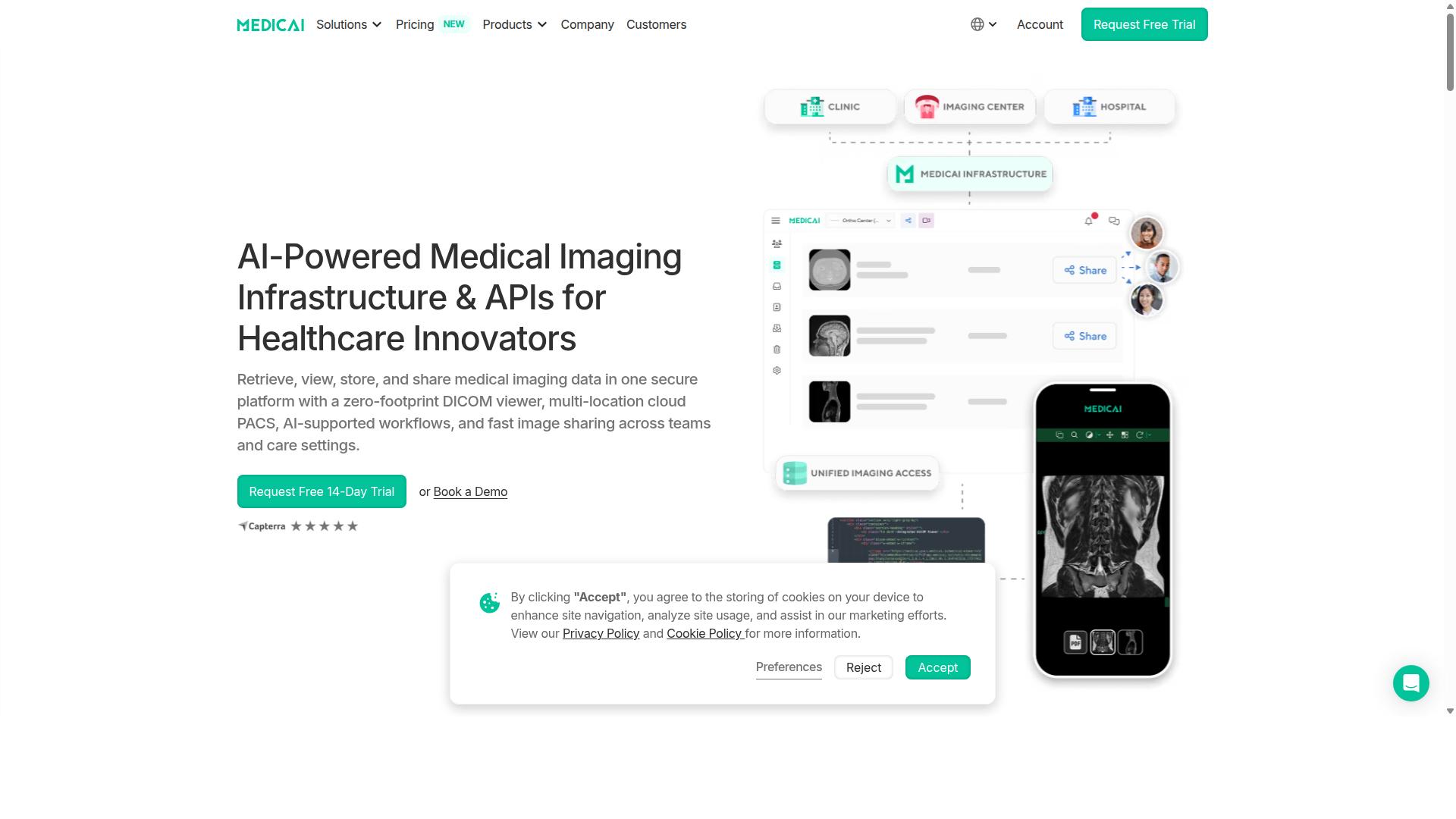
Medicai is a cloud-native medical imaging platform that lets providers upload, store, view and exchange DICOM studies through a browser-based zero-footprint viewer. The platform serves as a complete Cloud PACS solution that handles every stage of the radiology workflow from initial image capture to long-term archiving.
Core functions include the CONNECT & RETRIEVE uploader for importing studies from any modality. The STORE & MANAGE Cloud PACS system provides secure, scalable image archiving that meets HIPAA compliance standards and maintains data encryption throughout the storage lifecycle.
A VNA component ensures vendor-neutral archiving across different imaging departments and facilities. The image exchange feature allows secure study sharing between care teams while maintaining audit trails and role-based access controls for patient data protection.
Recent platform activity shows 1.7M+ studies in storage and 300k+ visualizations last year. This volume demonstrates the system handles real clinical workloads while supporting multi-location deployments and AI-supported workflows that improve diagnostic accuracy across different imaging modalities.
Unlike PostDICOM which takes a more limited approach to cloud PACS functionality, Medicai delivers Imaging Infrastructure as a Service that integrates with existing hospital systems. The zero-footprint viewer works on any device without software installation, making it practical for both on-site radiologists and remote specialists who need mobile access to patient studies.
What Is PostDICOM?
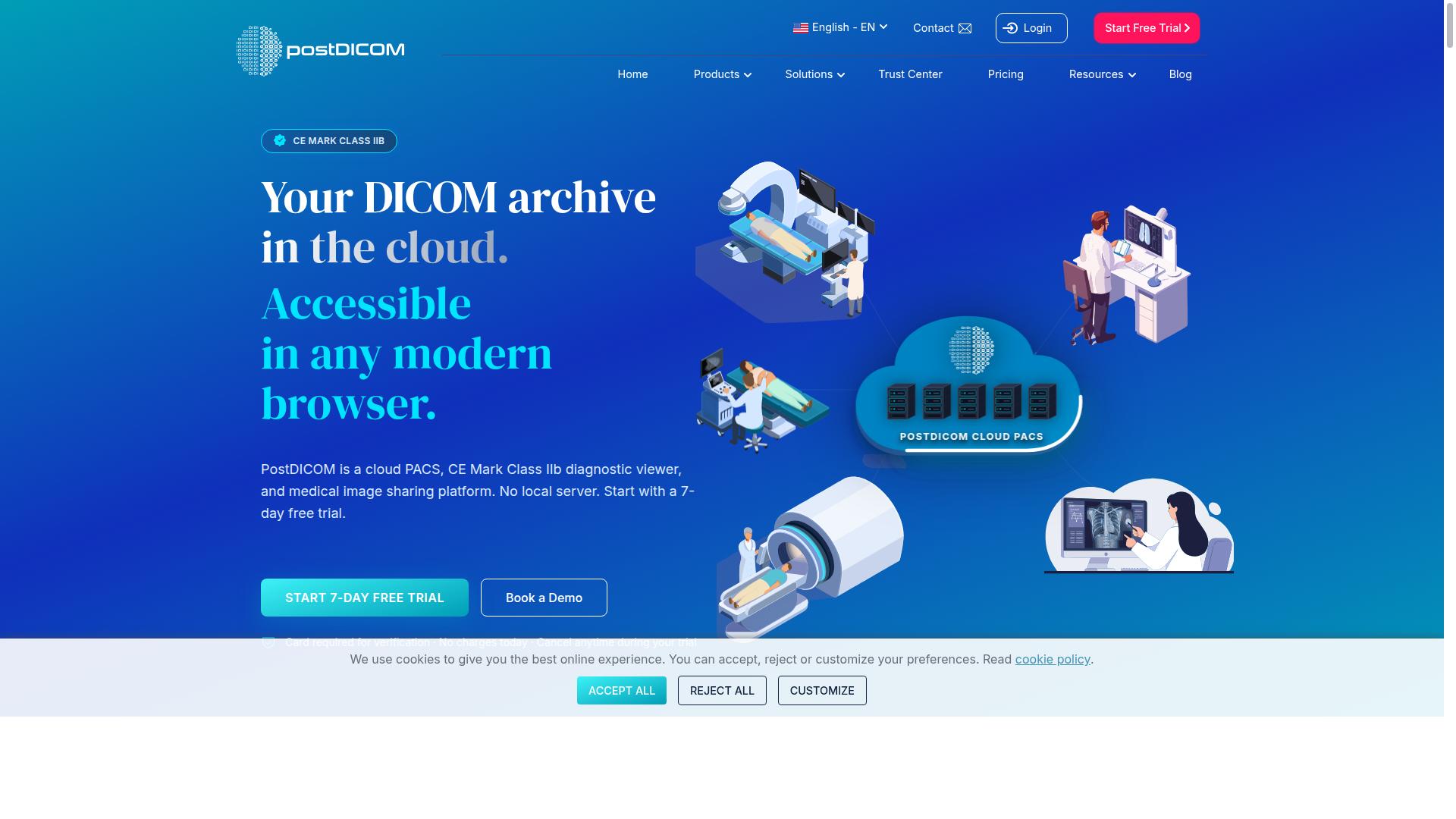
PostDICOM is a cloud-based PACS solution that provides medical image storage, DICOM viewing, and study sharing through a subscription service. Healthcare providers use this platform to access imaging studies across different locations and devices.
Users can upload DICOM files, view studies through a web browser, and share cases with referring physicians. The system supports multiple imaging modalities including CT, MRI, ultrasound, and X-ray examinations.
Cloud PACS platforms like PostDICOM aim to reduce infrastructure costs compared to traditional on-premise solutions. Organizations evaluate these services based on data security standards, integration capabilities, and overall workflow efficiency.
When comparing Cloud PACS options, facilities consider factors such as user interface design, mobile access features, and interoperability standards support. Research suggests that the right platform improves radiology workflow and supports diagnostic accuracy across different clinical settings.
Features Compared
This section breaks down head-to-head capabilities across storage, access, and security dimensions.
When comparing Cloud PACS vendors, focus on measurable metrics rather than marketing claims. Uptime reliability, integration capabilities, and audit trails provide concrete benchmarks for evaluation.
Teams should review documented performance data and compliance certifications before making decisions. These factors directly impact radiology workflow efficiency and diagnostic accuracy over time.
Storage, Backup & Disaster Recovery
Both platforms offer off-site storage, but Medicai Standard includes 2 TB plus automated backup and disaster recovery. The Vendor Neutral Archive supports standardized medical imaging formats across different equipment manufacturers.
Backup and Disaster Recovery services protect against data loss through automated processes. These capabilities matter for maintaining continuous access to patient studies during system disruptions.
PostDICOM provides cloud storage solutions with general backup options, though specific capacity details remain vendor-dependent. Storage approaches vary based on subscription tiers and data volume requirements.
Expert recommendations emphasize reviewing storage limits and recovery time objectives before selecting any platform. Data retention policies should align with regulatory requirements and clinical needs.
Multi-Location Support & Access
Medicai Standard supports one connected location out-of-the-box, while Starter is limited to local-only access. The Medical Image Exchange platform enables secure study sharing between authorized users across different sites.
Patient Case Management tools organize imaging data for remote review by multiple specialists. These features support teleradiology workflows and multidisciplinary tumor board discussions.
PostDICOM offers multi-site capabilities through its cloud infrastructure, though implementation details depend on specific configuration choices. Remote access functionality varies according to subscription level and network requirements.
Teams evaluating multi-location support should verify connectivity protocols and user access controls across different practice settings. Integration with existing hospital systems affects deployment timelines significantly.
Security & Compliance
Medicai is HIPAA and GDPR compliant, FDA/CEE cleared, and processes 50M+ yearly API transactions under strict audit trails. Role-based access controls limit data visibility according to user permissions and clinical roles.
Encryption protects medical imaging data during transmission and storage phases. Audit capabilities track user activities and study access patterns for compliance documentation.
PostDICOM implements standard security measures typical of cloud PACS platforms, with specific compliance features varying by deployment configuration. Security offerings should be verified directly with each vendor.
OWASP security guidelines provide additional framework for evaluating application security practices. Compliance documentation should include current certifications and regular audit schedules from any potential vendor.
Pricing Compared
Medicai charges a flat monthly fee with no per-study fees, while PostDICOM pricing is not detailed in this comparison. This structure makes costs predictable for radiology departments and imaging centers that process varying study volumes each month.
Two primary tiers define the Medicai offering. The Starter plan starts at $249 per month and includes 500 GB of cloud storage plus unlimited user accounts with no connected locations required.
The Standard plan costs $749 per month and expands capacity to 2 TB of cloud storage with one connected location. Both plans support unlimited users, which eliminates concerns about per-seat charges as teams grow.
Yearly billing reduces these rates by 15 percent. Organizations pay $209 per month for Starter or $639 per month for Standard when they commit annually. A one-time $1,000 DICOM Gateway setup fee applies per location for on-premise connectivity needs.
PostDICOM pricing details remain unavailable in this analysis. Without transparent information, facilities comparing Cloud PACS options must contact PostDICOM directly to understand subscription costs, storage limits, and any per-study charges that might apply.
Medicai includes a 14-day free trial of Starter plan features. No credit card is required to start. Enterprise customers can also request per-study pricing when their workflow demands variable billing based on actual usage patterns.
Who Should Choose Medicai
Hospitals, imaging centers, and specialty clinics handling high study volumes should consider Medicai when uptime reliability and 24/7 support are critical.
Healthcare providers across multiple specialties benefit from a Cloud PACS solution built for diverse medical imaging needs. Medicai serves orthopedics, neurology, oncology, radiology, cardiology, ophthalmology, ob-gyn, pulmonology, dentistry, and gastroenterology practices that require consistent access to patient studies.
Medical imaging workflows in these fields demand reliable systems that support multi-modality access and efficient image archiving. Large facilities processing 1M+ studies per year need a platform designed to maintain performance under heavy utilization.
The platform also supports virtual care providers, telemedicine platforms, and teleradiology services that require flexible access to diagnostic images. Personal injury lawyers, tumor boards, clinical trials, and medical education organizations find the system useful for collaborative review and documentation.
Patients benefit from the Patient Portal feature that allows secure access to their medical imaging records. This broad range of users indicates the platform handles varied workflow requirements across different healthcare settings.
Who Should Choose PostDICOM
Providers seeking a lightweight cloud PACS may evaluate PostDICOM for smaller imaging volumes. This option appeals to facilities that need basic medical imaging access without complex infrastructure requirements.
Smaller clinics often prioritize straightforward image archiving over advanced functionality. These practices typically manage lower daily study counts and require simpler storage arrangements.
Independent radiologists sometimes prefer solutions with minimal setup complexity. They may focus on essential DICOM viewer capabilities rather than extensive workflow customization options.
Budget-conscious organizations look for predictable subscription cost structures. PostDICOM attracts users who want cloud storage without significant upfront investment commitments.
Facilities with basic integration needs may find this approach sufficient. They often handle fewer interoperability standards requirements compared to larger healthcare networks.
Final Verdict
For facilities that need FDA-cleared compliance, 1.7M+ studies already archived, and transparent monthly pricing, Medicai offers a scalable cloud PACS.
Organizations that handle high imaging volumes require infrastructure that supports consistent performance across different regions. Medicai achieves this through 50M+ API transactions each year and global availability that keeps studies accessible regardless of location.
Enterprise-grade uptime remains a core requirement for radiology departments that cannot afford service interruptions during critical diagnostic windows. Medicai delivers this reliability through its established architecture that supports continuous access for medical imaging workflows.
Facilities evaluating PostDICOM against Medicai should consider their specific compliance needs and volume requirements. Medicai stands out when organizations prioritize verified regulatory clearance and proven study volume management.
Healthcare providers interested in exploring Medicai can contact the US office directly at 7901 4th St N, STE 300, St. Petersburg, FL 33702 or call +1 (832) 220 1035 to schedule a live demonstration of the platform capabilities.
Recommended Resources: