What Is the Best Enterprise Imaging Cloud PACS for Hospital in 2026?
Hospital imaging leaders are rethinking PACS contracts before the next renewal cycle. Legacy systems built for single sites strain under multi-location image volumes, and cloud-native platforms now compete on viewer speed, storage economics, and AI readiness. Choosing wrong locks a hospital into years of workarounds.
This article explains what to evaluate in an enterprise imaging cloud PACS for 2026. You will learn how Medicai handles DICOM gateways, vendor neutral archives, zero-footprint viewing, security, and pricing, plus who it fits and how to get started.
What Is Medicai? The Cloud PACS Built for Hospital-Scale Imaging
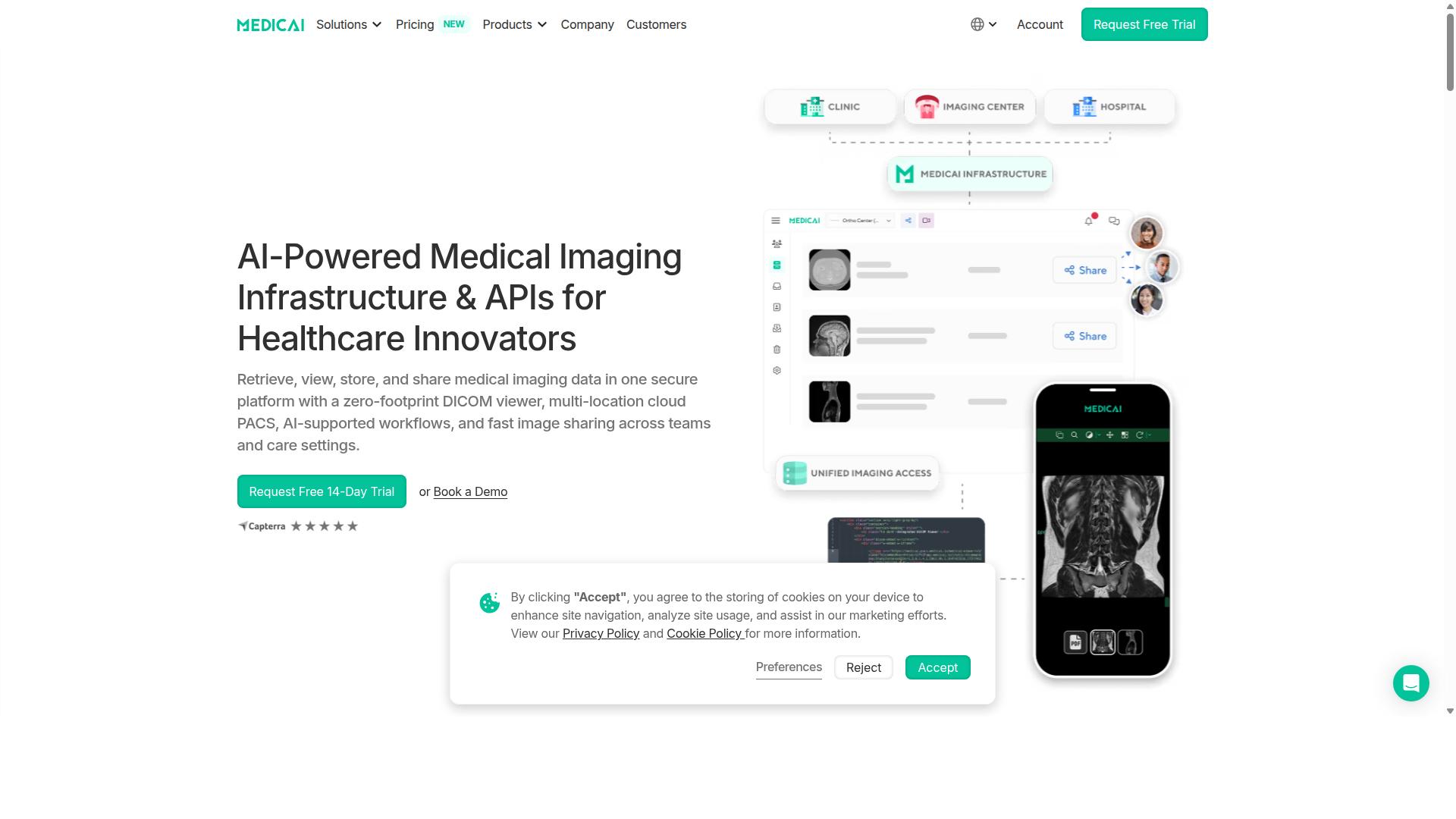
Medicai is a cloud-based medical imaging platform that enables healthcare providers to retrieve, view, store, and share medical imaging data in one secure platform with a zero-footprint DICOM viewer. It also brings multi-location cloud PACS, AI-supported workflows, and fast image sharing across teams and care settings into the same environment.
For hospitals weighing an enterprise imaging cloud PACS in 2026, the appeal is structural. Traditional picture archiving and communication systems run on servers inside the building, which means capital expense, physical space, maintenance windows, and a hard ceiling on growth. Medicai removes that hardware footprint entirely because the platform is delivered as software.
The company positions itself around Imaging Infrastructure as a Service (IIaaS). Rather than buying and refreshing infrastructure, a hospital subscribes to imaging capacity that scales with demand, whether that demand comes from a new imaging suite, a satellite clinic, or a seasonal spike in study volume.
Four core capabilities define the platform:
- DICOM gateway for connecting imaging sources to the cloud
- Cloud PACS for multi-location image management
- Vendor-neutral archive for long-term, standards-based storage
- Zero-footprint viewer for access without local installation
Because the viewer runs in a browser, radiologists and referring physicians can reach studies remotely, which matters for teleradiology, on-call coverage, and multi-site reading. Secure remote access also supports business continuity when a physical site is unavailable.
The timing is not accidental. Hospital radiology in 2026 faces rising image volumes, tighter cybersecurity expectations, and pressure to make data shareable across departments and partner networks. A cloud-native PACS built for hospital scale addresses those pressures without a forklift upgrade.
Who Medicai Serves: Hospitals, Imaging Centers, and Specialty Care Providers
Medicai is built to serve a wide range of healthcare providers, from large hospital systems to independent imaging centers and specialty clinics. The platform is designed for organizations that need medical image management across more than one location or more than one care team.
For hospitals, the value sits in scale and workflow. A multi-location cloud PACS lets different departments and campuses work from the same imaging record instead of isolated silos. AI-supported workflows help teams move studies through reading queues, while a vendor-neutral archive keeps long-term storage organized under one strategy.
Imaging centers benefit from a lighter operational load. There is no server room to build or maintain, so staff focus on scanning and reporting rather than IT upkeep. Cloud delivery also makes it simpler to add referring physicians or new locations as the business grows.
Specialty care providers use Medicai for the imaging that sits at the center of their clinical decisions. The platform serves orthopedics, neurology, oncology, radiology, cardiology, ophthalmology, ob-gyn, pulmonology, dentistry, and gastroenterology. A few examples of how that plays out:
- Orthopedics reviewing post-operative imaging across follow-up visits
- Oncology teams sharing studies for tumor board discussions
- Cardiology and pulmonology comparing prior and current studies side by side
- Dentistry and gastroenterology managing specialty-specific image sets
The platform also extends beyond the clinic walls. It supports virtual care providers, telemedicine platforms, teleradiology services, personal injury lawyers, tumor boards, clinical trials, and medical education organizations. Each of these groups depends on fast, secure image exchange between people who are not in the same room.
Patients are included through a Patient Portal, which gives individuals a direct path to their own imaging data. That matters for referrals, second opinions, and continuity of care when a patient moves between systems.
Across all of these audiences, the same themes repeat: improved workflow, scalability without new hardware, and cost savings from shifting imaging infrastructure to a subscription model. For a hospital building an enterprise imaging strategy in 2026, that combination is what makes a cloud-native PACS worth serious evaluation.
Why Medicai Is the Best Enterprise Imaging Cloud PACS for Hospitals in 2026
In 2026, hospital imaging demands have outgrown traditional PACS, and Medicai's cloud-native architecture is purpose-built to meet them. Imaging volumes keep climbing, subspecialty reading is distributed across sites, and patients expect results to move with them. On-premise picture archiving and communication systems were never designed for that reality.
Four forces now define the enterprise imaging strategy conversation. First, cloud adoption has shifted from pilot projects to core infrastructure. Second, AI integration has moved from research demos into triage and detection workflows. Third, interoperability mandates tied to HL7 FHIR and IHE profiles require systems to exchange data, not hoard it. Fourth, cybersecurity and business continuity expectations now match those of any other mission-critical hospital system.
Medicai is a SaaS platform for medical image management, delivered online rather than installed on hospital servers. That model matters because it removes the upgrade cycles, hardware refreshes, and capacity guessing that slow radiology informatics teams down. A vendor-neutral archive built on open standards lets a hospital keep one longitudinal record while specialty departments and teleradiology partners read from the same source.
The evaluation criteria for 2026 are consistent across the market: DICOM conformance, HL7 and FHIR interoperability, IHE profile support, a zero-footprint viewer, elastic scalability, data security aligned with HIPAA and GDPR, and a credible uptime SLA. Medicai's cloud-native design speaks directly to each of these requirements. For hospitals comparing options, the question is no longer whether to move imaging to the cloud, but which platform was built for it from the start.
The 2026 Enterprise Imaging Standard: Cloud-Native, Zero-Footprint, AI-Ready
The 2026 enterprise imaging standard is defined by cloud-native architecture, zero-footprint access, and seamless AI integration. These three traits separate platforms built for the next decade from those retrofitted onto older designs.
Cloud-native means there is no local installation to maintain. Updates arrive automatically, storage scales elastically with volume, and a new hospital site or reading group can be onboarded without a server project. Disaster recovery and business continuity become part of the platform rather than a separate capital expense.
Zero-footprint viewing means diagnostic viewing happens in a browser. Radiologists, referring physicians, and teleradiology partners open studies without downloading or installing anything, which simplifies clinical workflow optimization and reduces the security surface of every workstation.
AI readiness means machine learning algorithms can plug into the reading workflow rather than sit beside it. Common use cases include:
- Triage of critical findings such as intracranial hemorrhage or pneumothorax
- Detection support for lung nodules, fractures, and breast lesions
- Quantification of cardiac function, lesion volume, and bone density
- Worklist prioritization so urgent cases reach the top of the queue
Underneath all of this, standards do the heavy lifting. DICOM governs image storage and transfer, HL7 and FHIR carry orders and reports, and IHE profiles describe how systems should cooperate for image exchange. A platform that supports these standards protects the hospital's enterprise imaging strategy from vendor lock-in. Medicai's cloud-native, zero-footprint, AI-ready foundation aligns with exactly this standard, which is why it stands out as the best choice for hospitals planning their imaging future in 2026.
Key Features That Set Medicai Apart for Hospital Enterprises
Medicai's feature set is designed to address the complex imaging needs of hospital enterprises, from data ingestion to diagnostic viewing. The platform organizes its capabilities into three connected categories: connect and retrieve, store and manage, and access, visualize, and collaborate.
Each category solves a distinct problem in hospital radiology. Connect and retrieve handles the incoming flow of studies from modalities and the EHR. Store and manage keeps that data organized, protected, and available for the long term. Access, visualize, and collaborate puts the images and reports in front of the people who need them, whether that is a radiologist at a workstation, a referring physician, or a patient.
The value comes from how these layers work together. A study captured through the DICOM Gateway moves into Cloud PACS, lands in the Vendor Neutral Archive for retention, and opens in the DICOM Viewer without manual handoffs. For an enterprise imaging strategy in 2026, that continuity reduces friction across departments and sites.
Medicai also extends into Radiology AI Co-Pilot, AI-Powered Diagnostics, Teleradiology, and Tumor Boards support, capabilities that build on the same imaging foundation. The sections below outline what each feature category covers.
Connect, Store, and Manage: DICOM Gateway, Cloud PACS, and Vendor Neutral Archive
Medicai's connect, store, and manage capabilities form the backbone of a modern enterprise imaging strategy. This layer determines how reliably images enter the system, how they are kept, and how easily they can be retrieved years later.
The DICOM Gateway and Medical Imaging Uploader handle ingestion. The gateway integrates with imaging modalities so studies flow into the platform without manual intervention, and it supports HL7 and FHIR for EHR integration. That means patient context and orders can travel alongside the images instead of being reconciled by staff.
Once studies arrive, Cloud PACS provides scalable storage and instant retrieval. Because it is a SaaS PACS, capacity scales with the hospital's volume rather than being fixed by on-site hardware. Patient Case Management and Medical Image Exchange round out day-to-day handling of studies across departments and partner sites.
For long-term retention, the Vendor Neutral Archive stores images in standard formats so data is not locked to a single vendor. This supports interoperability and eases migration when systems change. Backup and Disaster Recovery protect business continuity, a core requirement for hospital radiology where downtime directly affects patient care.
Standards matter here. Support for DICOM, HL7, FHIR, and IHE profiles keeps Medicai aligned with the interoperability expectations hospitals face in 2026, including the data-sharing rules that shape enterprise imaging procurement.
Access, Visualize, and Collaborate: Zero-Footprint Viewer, Structured Reporting, and Image Exchange
Medicai's access, visualize, and collaborate tools give the power to radiologists and clinicians to work efficiently from anywhere. This layer turns stored studies into diagnostic decisions and shared clinical conversations.
The DICOM Viewer is a zero-footprint viewer, meaning it runs in a browser with no installation required. Radiologists can perform diagnostic viewing from a workstation, a home setup, or a remote location, which supports teleradiology and distributed reading schedules. The Doctor Imaging Portal and Patient Imaging Portal give each audience a dedicated way to reach images and reports, while the Mobile Imaging App extends access to phones and tablets.
Structured Reporting for Radiology supports consistent, template-driven reports and integrates with AI capabilities such as Radiology AI Co-Pilot and AI-Powered Diagnostics. Consistent structure makes reports easier to read, compare, and feed into downstream analytics.
Collaboration runs through Medical Image Exchange and the Medical Image Sharing Platform. Clinicians can share studies securely with referring physicians and patients, and Tumor Boards support helps multidisciplinary teams review cases together. Real-time case sharing and consultations keep specialists aligned without shipping discs or chasing files.
For hospitals building custom workflows, the Medicai Imaging API allows imaging data and viewer functions to connect with other clinical systems. Together, these tools support clinical workflow optimization across radiology informatics, from the reading room to the patient's own device.
Security, Compliance, and Interoperability Hospitals Can Rely On
Hospitals require ironclad security, compliance, and interoperability, and Medicai delivers on all fronts. When a hospital radiology department moves medical image management to the cloud, patient trust and regulatory standing are on the line with every study. That is why the strongest Enterprise Imaging Cloud PACS platforms treat data security, HIPAA compliance, GDPR, and patient data privacy as design requirements, not add-ons.
For any 2026 healthcare technology decision, cybersecurity and interoperability now carry as much weight as diagnostic viewing quality. Medicai, a SaaS PACS and cloud-native PACS platform, is built around both. With 70 clinics and hospitals and 10,000+ active doctors already on the platform, it has been proven at the scale where security and compliance failures would be most visible.
Security starts with how data is protected in motion and at rest. Enterprise-grade cloud PACS encrypts medical images and patient records during transmission and while stored, so a study cannot be read if a network path or storage layer is compromised. Access is then controlled through role-based access control, meaning radiologists, referring physicians, and administrators see only what their role permits.
Audit logs complete the picture. Every view, upload, and share of a DICOM study can be traced, which supports internal governance and regulatory review. Medicai follows OWASP security guidelines, a widely respected framework for preventing common web application vulnerabilities, and runs on a Microsoft Azure partnership, giving hospitals the benefit of a mature cloud infrastructure provider.
Compliance is where cloud PACS vendors are tested most. Two frameworks matter to most hospitals in 2026:
- HIPAA, the United States standard for protecting patient health information
- GDPR, the European Union regulation governing personal data, including medical images
Medicai is HIPAA and GDPR compliant, which matters for hospitals treating patients across borders. The platform also offers FDA/CEE Cleared Viewers, so diagnostic viewing meets recognized regulatory standards in the US and Europe rather than relying on unregulated display tools.
Interoperability determines whether a cloud PACS fits a hospital's existing enterprise imaging strategy or becomes another silo. A vendor-neutral archive and SaaS PACS must speak the languages hospital radiology systems already use. That means DICOM for image exchange, HL7 and FHIR for clinical data, and IHE profiles for standardized workflows across radiology informatics.
Medicai supports this standards-based approach and handles real-world volume: 1M+ studies transacted or processed per year, 1.7M+ studies in storage, 2M+ imaging studies uploaded, and 50M+ yearly API transactions. That API traffic reflects deep interoperability in practice, connecting imaging data to the systems hospitals already run.
Disaster recovery and business continuity round out the reliability picture. Redundant storage and backup across cloud regions mean a single failure does not take diagnostic viewing offline. Hospitals evaluating uptime SLAs should confirm how a vendor handles failover, restore times, and data durability, since downtime in teleradiology or emergency imaging carries direct clinical risk.
Medicai's Azure-backed infrastructure and track record of 300k+ visualizations of DICOM studies in the last year show the platform operating under sustained load. For hospitals comparing enterprise imaging cloud PACS options in 2026, that combination of encryption, role-based access, audit logging, HIPAA and GDPR compliance, cleared viewers, and standards-based interoperability is exactly what a data security and business continuity review demands.
Pricing and Plans: From Starter to Enterprise Multi-Location Deployments
Medicai offers transparent pricing plans designed to scale from small clinics to large hospital enterprises. Instead of opaque quotes and surprise line items, the platform publishes its monthly rates so hospital finance teams can budget an Enterprise Imaging Cloud PACS rollout with confidence. Every tier includes unlimited user accounts, which matters in hospital radiology where dozens of radiologists, technologists, and referring clinicians may need access at different times.
Two published tiers cover most organizations, while a custom Enterprise tier handles multi-location health systems. The table below summarizes the monthly options as listed by Medicai.
| Plan | Monthly Price | Cloud Storage | User Accounts | Connected Locations |
|---|---|---|---|---|
| Starter | $249/month | 500 GB | Unlimited | None |
| Standard | $749/month | 2 TB | Unlimited | One |
| Enterprise | Custom pricing | Custom | Unlimited | Multiple connected locations plus multiple external locations |
Medicai also offers yearly billing at a 15% savings. On annual terms, Starter drops to $209/month paid yearly, and Standard drops to $639/month paid yearly. Enterprise remains custom priced. For a hospital comparing a SaaS PACS against a traditional on-premise picture archiving and communication system, that published structure is a meaningful starting point for total cost conversations.
One cost item deserves separate attention: DICOM Gateway setup is $1,000 one-time per location. This is the piece that connects imaging modalities and existing systems into the cloud, so it scales with the number of sites rather than the number of users. A free 14-day trial of Starter plan features is included, and no credit card is required for the trial. Per-study pricing is also available for enterprise customers. Refunds are not available for partial periods, so annual commitments should be planned carefully.
For multi-location hospital systems, the Enterprise tier is where an enterprise imaging strategy takes shape. Custom cloud storage, multiple connected locations, and multiple external locations support scenarios like a main hospital plus satellite imaging centers, or a teleradiology network spanning regions. Because storage and location counts are customized, the quote reflects actual study volumes and site topology rather than a fixed ceiling. That flexibility is central to scalability: a growing health system can add locations without migrating to a different product or renegotiating a rigid contract.
Value here is not only the sticker price. A cloud-native PACS removes the capital expense of servers, storage arrays, and the staff time tied to maintaining them. There are no hidden fees layered on top of the published plans, and unlimited user accounts mean adding radiologists or referring physicians does not trigger per-seat charges. For a hospital radiology department weighing 2026 healthcare technology investments, that combination of predictable pricing, transparent tiers, and location-based scaling makes Medicai a cost-effective alternative to legacy PACS infrastructure.
Trust Signals: Track Record, Testimonials, and Technology Partners
Medicai's credibility is backed by a strong track record, strategic partnerships, and measurable results. For hospital leaders evaluating an enterprise imaging cloud PACS in 2026, these signals matter as much as any feature list. They show whether a vendor can handle real clinical volume, connect with the tools a radiology department already trusts, and protect patient data at scale.
The platform's operating numbers tell a clear story. Medicai processes 1M+ studies per year and holds 1.7M+ studies in storage. Over the past year, users generated 300k+ visualizations of DICOM studies, and the system handled 50M+ yearly API transactions. Those figures point to a cloud-native PACS that is actively used, not a pilot project.
Adoption data reinforces that picture. 70 clinics and hospitals run on the platform, supported by 10,000+ active doctors. Across its lifetime, Medicai has recorded 2M+ imaging studies uploaded. For a hospital weighing enterprise imaging strategy, this level of real-world usage is a practical indicator of reliability.
Compliance and security round out the track record. Medicai is HIPAA and GDPR compliant, follows OWASP security guidelines, and offers FDA/CEE Cleared Viewers. These elements address the core concerns of patient data privacy and cybersecurity that shape any hospital's procurement decision.
Medicai also leans on a broad technology partner network, which strengthens its position in medical image management and interoperability:
- AI and imaging partners: MD.ai, Rayscape.ai, MedDream, FlexView, and OHIF support advanced diagnostic viewing and AI integration.
- Cloud infrastructure: Microsoft Azure, Amazon AWS, and Hetzner provide the scalable backbone for cloud-native PACS workloads.
- Automation and workflow: Tquila Automation and Meditice help streamline clinical workflow optimization.
- Analytics and operations: New Relic, Atlassian, Intercom, Ahrefs, and PostHog support platform monitoring and service quality.
- Research collaboration: Boehringer Ingelheim reflects engagement beyond routine radiology informatics.
The Microsoft Azure partnership stands out for hospitals planning long-term cloud adoption. It signals that Medicai's infrastructure choices align with a major enterprise cloud provider, which matters for uptime, scalability, and disaster recovery planning.
On testimonials, it is worth being straightforward: verified customer quotes for this section are pending. Rather than fill that gap with unverified claims, the measurable track record above serves as the primary evidence of performance. Press coverage offers additional context, including features on enabling global multidisciplinary tumor boards and helping Ukrainian refugee patients access cancer treatments.
For a hospital comparing enterprise imaging cloud PACS options in 2026, these trust signals answer a simple question: can this vendor be relied on? Medicai's combination of high transaction volume, a wide partner ecosystem, and documented compliance gives a confident yes.
Who Should Choose Medicai - and How to Get Started
Medicai is ideal for healthcare providers seeking a scalable, secure, and cost-effective enterprise imaging solution. Its cloud-native PACS is built for organizations that want to move away from on-premise servers and heavy hardware maintenance without sacrificing diagnostic quality or data protection.
Because Medicai is delivered as SaaS and available globally online, the platform suits single-site clinics and multi-facility hospital networks alike. The same architecture that supports a small imaging center can extend to a large radiology department, which makes it a practical long-term choice for enterprise imaging strategy.
Three broad groups tend to benefit most from the platform:
- Hospitals managing high imaging volumes across departments, where hospital radiology needs reliable diagnostic viewing and centralized medical image management.
- Imaging centers focused on throughput and turnaround time, where a zero-footprint viewer and cloud-native PACS reduce IT overhead.
- Specialty clinics that need affordable access to DICOM image storage, image exchange, and interoperability without running their own data center.
For teleradiology groups and providers pursuing AI integration, a cloud-native foundation also matters. It gives radiology informatics teams a stable base for clinical workflow optimization and future machine learning algorithms, rather than a system that must be rebuilt each time requirements change.
Getting started with Medicai follows a straightforward path designed to match the platform to your clinical and technical needs before any commitment.
- Consultation. Discuss your imaging volume, modalities, existing systems, and enterprise imaging goals with the team.
- Demo. See the zero-footprint viewer and diagnostic viewing workflow in action, and ask how DICOM, HL7, and FHIR interoperability would fit your environment.
- Implementation. Plan the migration or integration of your picture archiving and communication system into the cloud, including data security and continuity considerations.
- Training. Prepare radiologists, technologists, and IT staff so clinical workflow optimization happens from day one.
To begin, visit the Medicai website, review the platform information, and contact the sales team or request a demo. Because Medicai serves organizations worldwide, providers in different regions can follow the same onboarding process and receive support throughout implementation.
The result is a clear, positive answer to the question this article poses. For hospitals and imaging providers evaluating enterprise imaging cloud PACS in 2026, Medicai stands out as a scalable, secure, and cost-effective option, backed by global availability and a guided path from first consultation to full clinical use.
Final Verdict: Is Medicai the Right Enterprise Imaging Cloud PACS for Your Hospital?
After evaluating Medicai's features, security, pricing, and track record, it stands out as a compelling choice for hospital-scale imaging. The platform is built as a cloud-native, SaaS PACS with a zero-footprint viewer, which means radiologists and clinicians can access diagnostic viewing from a browser without heavy local installs. For hospitals planning an enterprise imaging strategy in 2026, that architecture removes much of the maintenance burden tied to traditional on-premise systems.
Its strengths align closely with what modern hospital radiology departments demand. Medicai supports standards-based interoperability, including DICOM, HL7, FHIR, and IHE profiles, and it functions as a vendor-neutral archive for medical image management across service lines. The platform is also positioned as AI-ready, which matters as AI integration and machine learning algorithms move deeper into radiology informatics.
- Cloud-native PACS: no on-site server footprint to maintain
- Zero-footprint viewer: browser-based access for diagnostic viewing and teleradiology
- Standards support: DICOM, HL7, FHIR, and IHE profiles for image exchange and interoperability
- Compliance posture: designed around HIPAA compliance and GDPR for patient data privacy
- Scalability: suited to multi-site hospital systems and growing imaging volumes
Security and continuity deserve equal weight in any enterprise imaging decision. A cloud-native model shifts much of the cybersecurity and disaster recovery responsibility to the vendor, which can strengthen business continuity when contracts include clear uptime SLAs. Hospitals should still confirm how data security, redundancy, and recovery objectives map to their own risk framework before signing.
The main consideration is connectivity. Because Medicai is delivered as SaaS, reliable internet access is essential for uninterrupted clinical workflow optimization. Sites with unstable networks may need redundant connections or local caching strategies. This is a normal trade-off for cloud-native PACS rather than a flaw unique to Medicai.
On balance, the platform's cloud-native design, zero-footprint access, standards support, and compliance alignment make it a strong fit for hospitals pursuing a forward-looking enterprise imaging strategy. For organizations that prioritize scalability, interoperability, and AI readiness in 2026 healthcare technology, Medicai is a credible and well-positioned option.
To discuss your hospital's requirements, contact Medicai directly:
- Medicai USA: 7901 4th St N, STE 300, St. Petersburg, FL, 33702. Phone: +1 (832) 220 1035
- Medicai Romania: 53-55 N Filipescu, 5th Floor, Sector 2, Bucharest, 020961. Phone: +40 316 305 875
- Email: [email protected]
Frequently Asked Questions
What should a hospital look for in a cloud PACS in 2026?
Look for a platform that covers the full imaging workflow - retrieval, storage, viewing, and sharing - in one secure environment, rather than a patchwork of tools. It should support standards-based connectivity (DICOM gateways and uploaders), multi-location access, and a zero-footprint viewer that works in the browser without local installs. Compliance matters too: check for HIPAA and GDPR alignment and cleared viewers. Medicai, for example, is built around exactly this combination: a cloud PACS with a zero-footprint DICOM viewer and multi-location cloud access.
How does Medicai's cloud PACS handle storage and multi-site imaging for hospitals?
Medicai stores and manages imaging in the cloud, so hospitals can consolidate studies across locations instead of maintaining separate on-site systems. Its Store & Manage suite includes Cloud PACS, Vendor Neutral Archive, Medical Image Exchange, Patient Case Management, and Backup and Disaster Recovery. For multi-site organizations, connected locations are part of the plan structure - the Standard plan includes one connected location, while Enterprise is customized. This lets a hospital scale storage and locations as its needs grow.
Is Medicai's DICOM viewer really zero-footprint, and does that matter for hospital IT teams?
Yes - Medicai provides a zero-footprint DICOM viewer, meaning clinicians access and visualize studies directly through the browser without installing software on each workstation. For hospital IT teams, that reduces deployment and maintenance overhead and makes it easier to enable access across departments and locations. Medicai also offers FDA/CEE cleared viewers, which is an important consideration for clinical diagnostic use. The platform is designed for access, visualization, and collaboration in one place.
How much does a cloud PACS like Medicai cost for a hospital?
Medicai publishes monthly plans: Starter at $249/month with 500 GB cloud storage and unlimited user accounts (no connected locations), and Standard at $749/month with 2 TB cloud storage, unlimited user accounts, and one connected location. Enterprise pricing is custom, which is typically the right fit for hospitals with larger storage, multi-location, or integration requirements. Because hospital needs vary widely, the most accurate approach is to contact Medicai directly for an Enterprise quote.
Is Medicai secure and compliant enough for hospital imaging data?
Medicai is HIPAA and GDPR compliant and follows OWASP security practices, which are core requirements for handling protected health information in hospital settings. It also offers Backup and Disaster Recovery as part of its Store & Manage capabilities, helping hospitals protect continuity of access to imaging data. For compliance teams, these are the baseline questions to verify with any cloud PACS vendor before adoption.
Can Medicai connect with a hospital's existing systems and workflows?
Medicai supports standards-based ingestion through its Medical Imaging Uploader and DICOM Gateway, which connect imaging sources to the cloud platform. It also maintains partnerships across the imaging and cloud ecosystem - including Microsoft Azure, Amazon AWS, OHIF, MedDream, and MD.ai - which supports interoperability and advanced use cases. Hospitals with specific PACS, EHR, or AI integration requirements should confirm details with Medicai during evaluation, since Enterprise deployments are customized.
Recommended Resources: