Top 9 Alternatives of AWS HealthImaging for Zero-Footprint Diagnostic Viewing
Many hospital teams hit storage limits or pay rising fees each month when their current imaging platform cannot handle rising scan volumes. The switch usually starts with a single pain point such as slow uploads or restricted remote access. These constraints push radiology groups, clinics, and teleradiology firms to compare zero-footprint viewers that keep data secure while remaining browser-based.
By the end of this article you will know which nine platforms meet diagnostic standards, how each handles encryption, vendor-neutral archives, and AI routing, and why Medicai tops the list on these three criteria. The comparison ends with a short decision guide that matches your workflow size and compliance needs to the right tool.
What to Look For in Zero-Footprint Diagnostic Viewing Solutions
Evaluate zero-footprint viewers against security, integration, and scalability criteria before selecting a platform.
Security requirements form the foundation. Verify HIPAA/GDPR/SOC2 compliance with documented audit logging frequency, as regulatory frameworks demand consistent activity tracking across all user interactions.
Integration capabilities determine workflow efficiency. Check HL7/FHIR integration capabilities including modality worklist support to ensure seamless communication between imaging systems and electronic health records.
Standard compliance affects data exchange. Confirm DICOMweb/WADO-RS/QIDO-RS/STU-RS standards compliance to enable consistent image retrieval across different vendor platforms and healthcare networks.
Advanced visualization tools support clinical decisions. Assess 3D reconstruction and multiplanar reconstruction features that allow radiologists to examine anatomical structures from multiple angles without additional hardware.
Storage optimization impacts operational costs. Review lossless compression ratios and storage efficiency metrics to understand how each platform balances image quality with archive space requirements.
Access management protects patient data. Evaluate role-based access and single sign-on implementation methods to ensure appropriate permissions while maintaining efficient login processes for clinical staff.
1. Medicai - Best Overall
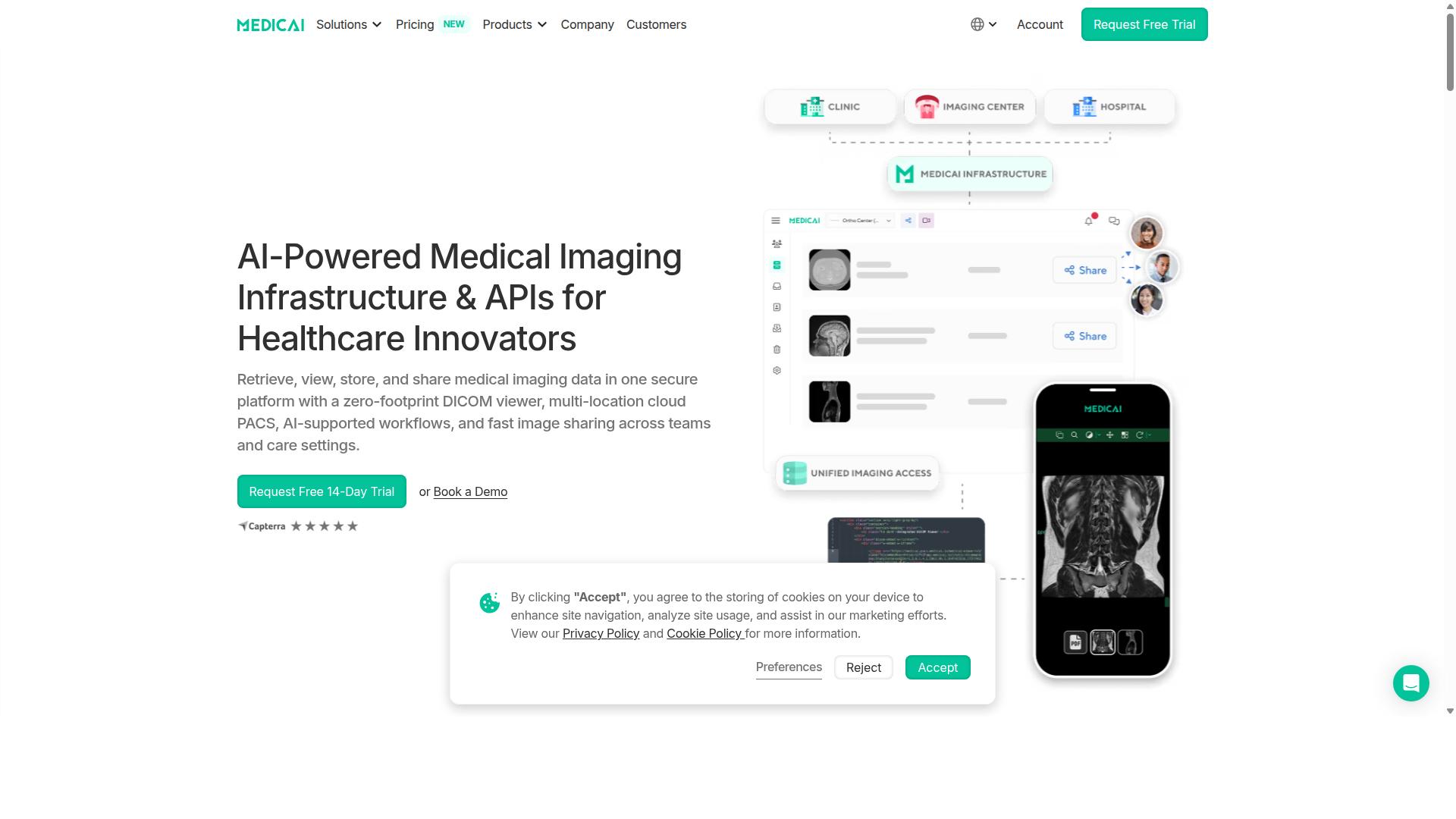
Medicai provides a cloud-based medical imaging platform with zero-footprint DICOM viewer capabilities. The platform offers healthcare providers a complete solution for retrieving, viewing, storing, and sharing medical imaging data in one secure environment.
Performance indicators show the platform processes 1M+ studies yearly while handling 50M+ API transactions annually. Current storage holds 1.7M+ studies across 70 clinics and hospitals with 10,000+ active doctors using the system.
Key capabilities include multi-location cloud PACS functionality, AI-supported workflows, and fast image sharing across teams and care settings. The platform operates as Imaging Infrastructure as a Service and focuses on modernizing medical imaging workflows while enabling interoperability between healthcare systems.
Security and Compliance Features
Medicai maintains HIPAA and GDPR compliance with FDA/CEE cleared viewer technology. The platform follows OWASP security guidelines throughout its infrastructure and operations.
Audit logging capabilities track all user interactions and system events for compliance reporting requirements. Role-based access controls ensure users see only the imaging data and features appropriate to their clinical roles and responsibilities.
Healthcare organizations can rely on established security frameworks without additional configuration. These compliance measures support healthcare providers in meeting regulatory requirements across different jurisdictions and care settings.
Integration and Workflow Capabilities
The platform supports HL7 integration, FHIR API access, and DICOMweb standards for seamless workflow integration. Medical imaging uploader and DICOM gateway services connect existing imaging equipment to the cloud platform.
Modality worklist support allows radiology departments to manage imaging orders efficiently within existing hospital information systems. Structured reporting for radiology enables consistent documentation across different imaging studies and clinical teams.
Doctor imaging portal and patient imaging portal provide appropriate access levels for clinical staff and patients. Mobile imaging app extends viewing capabilities beyond traditional workstation environments while maintaining security standards.
Storage and Scalability Options
Medicai offers scalable cloud storage with Starter and Standard tiers beginning at $249/month. The Starter plan provides 500 GB cloud storage with unlimited user accounts while the Standard plan includes 2 TB storage capacity with one connected location.
Enterprise customers benefit from custom pricing options that accommodate multiple connected locations and external partnerships. Current platform usage demonstrates scalability with 1.7M+ studies currently stored and 2M+ imaging studies uploaded to date.
Cloud PACS functionality, vendor neutral archive services, and backup capabilities ensure data availability across healthcare networks. These storage options support organizations transitioning from traditional PACS systems to cloud-based imaging infrastructure.
2. Intelerad
Intelerad provides enterprise imaging solutions with teleradiology capabilities.
The platform supports enterprise image exchange across healthcare networks. It enables secure sharing and access of medical imaging studies between different providers and locations.
Hospitals and large health systems use this type of enterprise imaging platform to unify records from multiple departments including radiology, cardiology, and pathology.
The solution integrates with vendor-neutral archives to help organizations consolidate their imaging data from various sources into a single accessible repository.
Healthcare facilities seeking a PACS alternative often evaluate Intelerad when they need to connect multiple sites and support remote reading workflows across their network.
3. ProtonPACS
ProtonPACS offers cloud-based PACS services for healthcare facilities. The platform centralizes storage and management of medical images from MRI, CT, x-ray, ultrasound and other modalities. It serves radiology professionals, orthopaedic practices, hospitals and imaging centers.
Advanced workstations include AI tools and 3D reconstruction capabilities. Automated measurements and worklist automation help streamline daily workflows. Real-time updates keep teams current across multiple locations.
Multi-device accessibility supports radiologists who need to review studies from anywhere. The system provides HIPAA-compliant security for sensitive patient data. Integration with RIS and EMR platforms helps maintain existing clinical workflows.
Facilities seeking a PACS alternative often evaluate ProtonPACS when they require reliable cloud imaging. The service combines diagnostic imaging tools with enterprise imaging features. This approach suits organizations moving away from traditional on-premise solutions.
Staff can access a radiology workstation through standard web browsers. This setup supports zero-footprint diagnostic viewing across departments. The platform handles modality worklist management and supports various DICOM viewer requirements.
4. Sectra
Sectra delivers enterprise imaging solutions across multiple medical specialties. Their platform supports radiology, breast imaging, cardiology, digital pathology, orthopaedics, and several other clinical areas through a unified system approach.
Sectra offers several products including Sectra One Cloud, Sectra IDS7, and Sectra UniView for different clinical workflows. These tools work together to handle image storage, viewing, and reporting needs in hospital environments.
The company also provides Sectra VNA, Sectra Reporting, and Sectra Image Exchange Portal as part of their broader enterprise imaging portfolio. More than 2,500 healthcare sites worldwide currently use these systems for daily operations.
Sectra PACS has maintained top customer satisfaction rankings in industry surveys for thirteen consecutive years. Their solutions serve both large hospital networks and smaller facilities that need reliable imaging infrastructure.
Users can access images through web-based interfaces that require no local software installation. This approach aligns with modern requirements for zero-footprint diagnostic viewing across different departments and locations.
5. PostDICOM
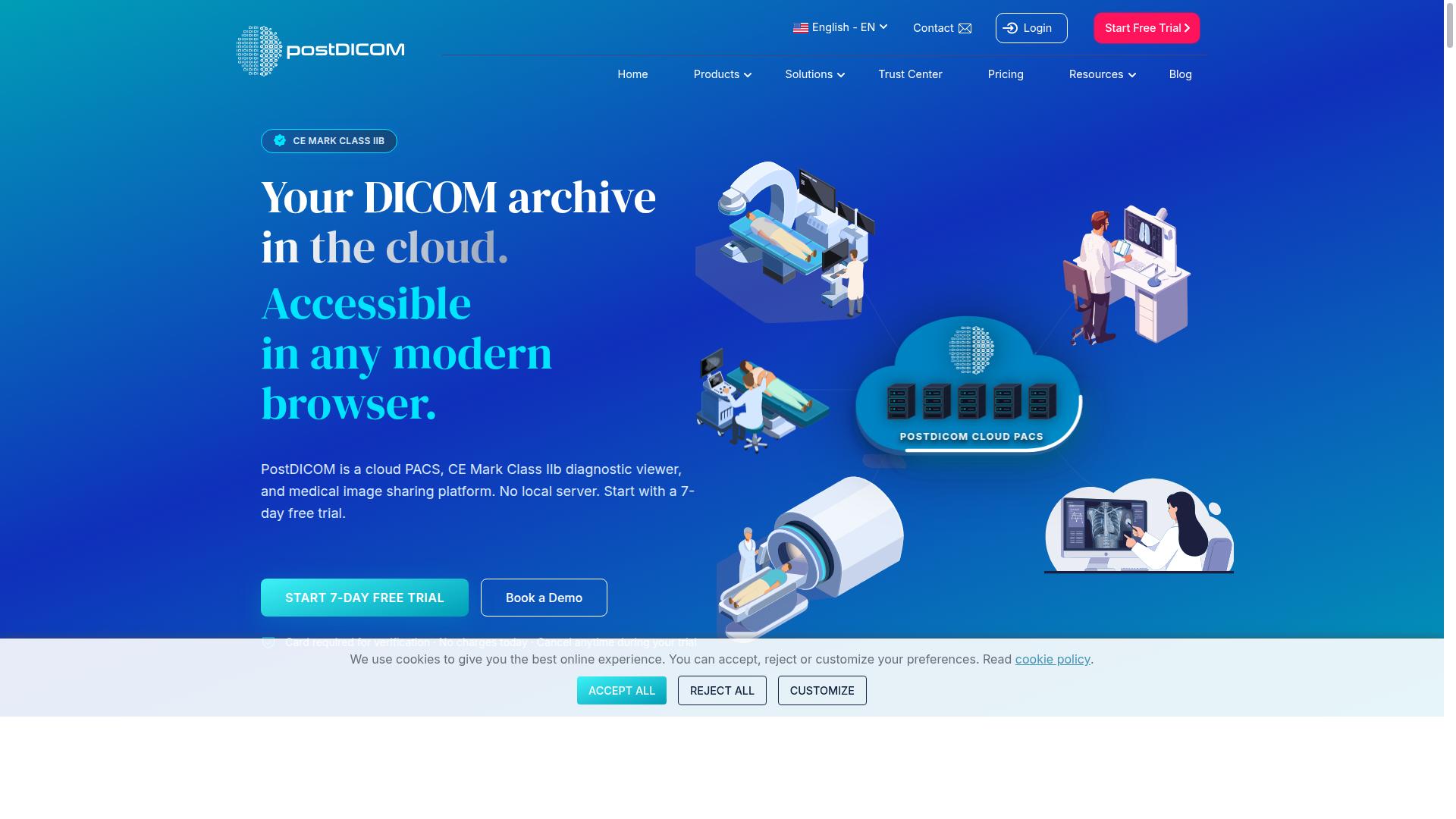
PostDICOM provides cloud-based DICOM viewing and storage services. The platform supports hospitals, clinics, and research institutions that need a zero-footprint viewer accessible through standard web browsers.
Users can open studies without installing applications on local machines. This approach simplifies deployment across multiple sites and reduces hardware requirements at each location.
The service includes multiplanar reconstruction, three-dimensional rendering, and measurement tools. These capabilities support routine reading and specialized diagnostic workflows in a single interface.
PostDICOM stores data across twelve Microsoft Azure regions. Compliance certifications include HIPAA, GDPR, ISO 13485, and ISO 27001.
Sharing features allow clinicians to send images through password-protected links. This capability helps teams coordinate care across different organizations without complex setup.
Additional tools support teaching libraries for universities and veterinary imaging workflows. Each plan offers a seven-day trial period for evaluation.
6. PaxeraHealth
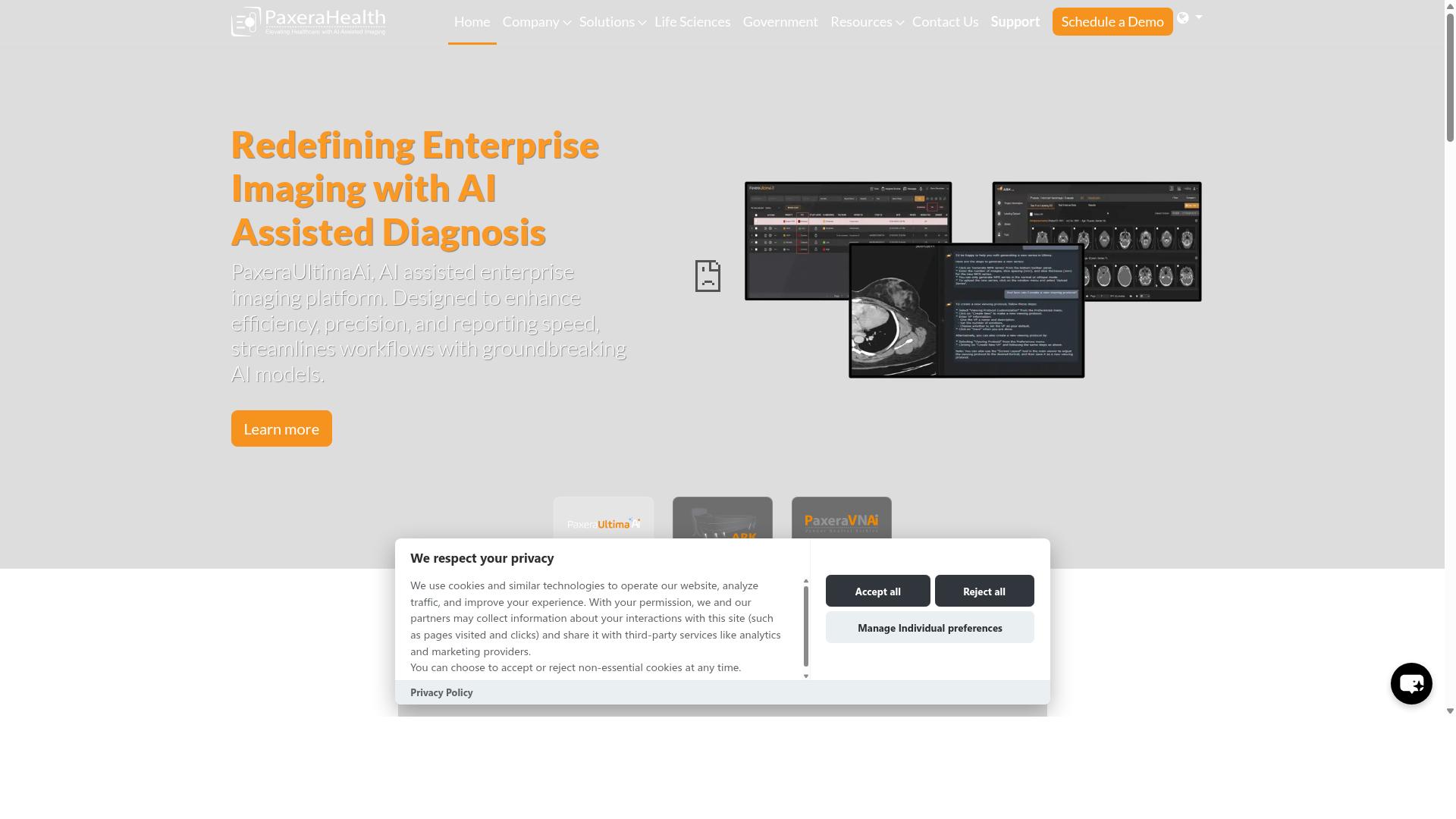
PaxeraHealth offers PACS solutions for diagnostic imaging workflows. Their platform supports zero-footprint diagnostic viewing that lets radiologists access studies through any browser. This approach removes the need for local software installations.
The system provides AI-assisted diagnosis features that help detect abnormalities and speed reporting. Automated algorithms handle tasks like spine labeling and organ volumetry. These tools reduce manual work for radiologists during routine reads.
Enterprise imaging capabilities include a vendor-neutral archive that manages images throughout their lifecycle. The platform supports cardiology and mammography modules in addition to standard radiology workflows. Hospitals and research centers can consolidate multiple imaging departments into one system.
Mobile access through dedicated apps allows clinicians to review studies on tablets and smartphones. Image sharing features facilitate collaboration between different healthcare facilities. The platform maintains HIPAA-compliant security standards for all data transmission and storage.
PaxeraHealth addresses the limitations of traditional AWS HealthImaging setups by combining PACS functionality with AI tools. Organizations looking for a unified medical imaging platform can evaluate this option for teleradiology and cross-enterprise document sharing needs.
7. Sirona Medical
Sirona Medical provides cloud-based radiology solutions. The platform delivers cloud-native, zero-footprint radiology software that supports diagnostic imaging workflows without requiring local installation.
Healthcare organizations seeking cloud imaging options often evaluate platforms like Sirona for radiology practices. The software operates through web browsers and supports standard DICOM viewer functionality across different clinical settings.
Medical facilities exploring PACS alternative solutions might consider how Sirona fits within broader enterprise imaging strategies. The cloud approach eliminates some infrastructure requirements that traditional systems demand.
Professionals comparing AWS HealthImaging alternatives review cloud imaging vendors based on workflow compatibility and accessibility. Sirona Medical represents one option among several available platforms for teleradiology and diagnostic viewing needs.
Organizations evaluating medical imaging platforms should assess how cloud solutions connect with existing HL7 integration requirements and modality worklist systems. The vendor neutral archive approach helps consolidate image storage across multiple sources.
8. Fujifilm
Fujifilm delivers enterprise imaging solutions with diagnostic capabilities. Their offerings support hospitals and health systems that need consolidated image management across multiple clinical departments.
The platform combines radiology, cardiology, and pathology workflows into a single patient view. This approach helps eliminate fragmented technologies that can increase IT overhead in large organizations.
Secure access to both DICOM and non-DICOM images remains available through browser-based interfaces. Users can view studies without installing additional software on local workstations.
Server-side rendering forms a core component of their zero-footprint viewer strategy. This architecture supports various browser and operating system combinations without requiring local processing resources.
Additional capabilities include worklist orchestration and analytics tools. These features assist with scheduling intelligence and performance monitoring across enterprise imaging environments.
Content storage follows vendor neutral archive principles, which maintain images in native format. This method supports long-term retention requirements while enabling cross-departmental access.
9. Exa PACS
Exa PACS provides cloud-based PACS services for medical imaging.
This platform supports radiology groups through an integrated imaging workflow solution. It combines PACS and RIS functions in a single database structure.
The system includes a zero-footprint viewer that operates on standard computers without requiring downloads or installations.
Server-side rendering handles image processing remotely. This approach maintains performance across various connection speeds and network conditions.
Security features keep all patient data stored on servers rather than local workstations. This design reduces exposure risks during teleradiology operations and remote diagnostic viewing sessions.
The platform supports multiple specialties including mammography, cardiology, and orthopedic imaging. Different versions address specific clinical requirements from full enterprise deployments to lighter configurations.
Users can access imaging studies through web browsers on various devices. The cloud architecture eliminates the need for local hardware maintenance and upgrades.
Integration capabilities include connections with existing hospital systems and radiology information systems. These connections support data exchange while maintaining compliance with healthcare data standards.
How to Choose the Right Option
Selection criteria should align with specific healthcare provider requirements and workflow needs. Hospitals, imaging centers, and specialty care providers must evaluate how each medical imaging platform handles their unique case volumes and specialty requirements.
Orthopedics and neurology teams often need advanced measurement tools and multiplanar reconstruction capabilities. Oncology and cardiology practices require robust annotation features and seamless integration with existing clinical workflows.
Ophthalmology, ob-gyn, and pulmonology departments face distinct imaging challenges that demand flexible viewing options. Dentistry and gastroenterology practices benefit from platforms that accommodate their specific modality types and reporting needs.
A zero-footprint viewer eliminates installation requirements while maintaining diagnostic quality across different devices. Cloud imaging solutions offer scalability that traditional PACS systems cannot match when patient volumes fluctuate.
HIPAA compliance and role-based access controls protect patient data while enabling appropriate sharing across care teams. HL7 integration and FHIR API capabilities ensure the platform connects smoothly with existing hospital information systems.
Virtual care providers and teleradiology services require reliable remote access without compromising image quality. Tumor boards and clinical trials need collaborative features that support multi-user review sessions.
Medical education organizations benefit from platforms that support teaching workflows and case sharing. Personal injury lawyers need secure access to imaging studies for legal proceedings.
Consider whether the platform supports DICOMweb standards including WADO-RS, QIDO-RS, and STU-RS for modern interoperability. Vendor neutral archive capabilities prevent vendor lock-in and support enterprise imaging strategies.
Lossless compression maintains diagnostic integrity while reducing storage costs. Audit logging and single sign-on features enhance security compliance across healthcare organizations.
Final Verdict
Medicai emerges as the leading choice among zero-footprint diagnostic viewing solutions based on comprehensive feature evaluation.
The platform demonstrates strong performance through its ability to handle 1M+ studies processed yearly while maintaining 300k+ DICOM visualizations. This level of activity surpasses typical usage patterns seen across most medical imaging platforms.
Security credentials set Medicai apart from competing solutions. HIPAA and GDPR compliance combined with FDA/CEE cleared viewers provide regulatory assurance that many alternatives lack.
API transaction volume reaches 50M+ yearly transactions, indicating robust integration capabilities for healthcare systems requiring frequent data exchange. This capacity supports enterprise-scale deployments that demand reliable connectivity.
The platform serves 70 clinics and hospitals with over 10,000 active doctors, representing real-world adoption across diverse clinical settings. Current storage includes 1.7M+ studies with 2M+ imaging studies uploaded total.
Clinical efficiency improvements include a documented 65% reduction in diagnosis time through streamlined workflows. The Microsoft Azure partnership further strengthens infrastructure reliability for organizations already invested in that ecosystem.
International collaboration features enable global multidisciplinary tumor boards, demonstrating practical utility beyond standard viewing functions. The platform also supports patient access programs, including initiatives for Ukrainian refugee patients requiring cancer treatment coordination.
Recommended Resources: