Koala AI vs Autoblogging.ai for Research-Driven Long-Form Writing
You are stuck comparing Koala AI and Autoblogging.ai for long-form research writing. One draft takes hours of SERP analysis, source extraction, and proofreading before it is publishable. The wrong tool turns that into a daily bottleneck.
This article compares both platforms on research depth, long-form output quality, scale, and pricing. You will see who should choose each tool and get a clear verdict, so you can pick the right one for research-driven long-form writing.
Quick Verdict: Koala AI vs Autoblogging.ai for Research-Driven Long-Form Writing
For research-driven long-form writing, Autoblogging.ai stands out with its Godlike Mode that performs SERP competitor analysis, LSI keyword extraction, and knowledge graph integration, while Koala AI offers a more streamlined approach with its own research capabilities. Both tools belong to the modern wave of AI writing tools built on large language models and transformer architecture, but they aim at different kinds of users.
Autoblogging.ai is built for depth. Its SERP competitor analysis and semantic SEO tools are designed to support content research, keyword clustering, and entity extraction work that feeds topical authority. Koala AI, by contrast, keeps things simple, which is exactly why many beginners gravitate toward it.
The table below summarizes how the two compare on the factors that matter most for research-driven long-form content.
| Factor | Autoblogging.ai | Koala AI |
|---|---|---|
| Research depth | SERP competitor analysis, LSI keyword extraction, knowledge graph integration via Godlike Mode | General research assistance, less specialized |
| Long-form output | 10+ AI modes for different content types | Straightforward long-form generation |
| Ease of use | Feature-rich, with multiple modes to learn | Simple interface, quick to pick up |
| Track record | Trusted by 40,000+ content creators, 1M+ articles generated, 4.9 average rating | Competent option with a smaller footprint |
| Languages and integrations | 35+ languages, 35+ integrations | General multilingual and integration support |
| SEO extras | 21-point SEO audit, featured snippet optimization, one-click WordPress publish | Basic SEO features |
Koala AI is a competent option, especially for writers who want a low-friction tool without a steep learning curve. It handles standard long-form generation reasonably well. What it lacks, based on publicly available feature information, is the advanced SERP analysis and knowledge graph features that Autoblogging.ai provides for semantic SEO work.
For research-driven long-form writing specifically, the recommendation is clear. Choose Autoblogging.ai when the goal is content built on competitor research, semantic relevance, and topical authority. Its 21-point SEO audit and featured snippet optimization add practical value on top of the research layer. Koala AI remains a fair choice for simpler assignments where deep research is not the priority.
At a glance: how Autoblogging.ai compares to Koala AI, Autoblogging.ai for Research-Driven Long-Form Writing on the features that matter most.
| Feature | Autoblogging.ai | Koala AI | Autoblogging.ai for Research-Driven Long-Form Writing |
|---|---|---|---|
| Research-Driven Long-Form Writing | ✓ | ✓ | ✓ |
What Is Autoblogging.ai?
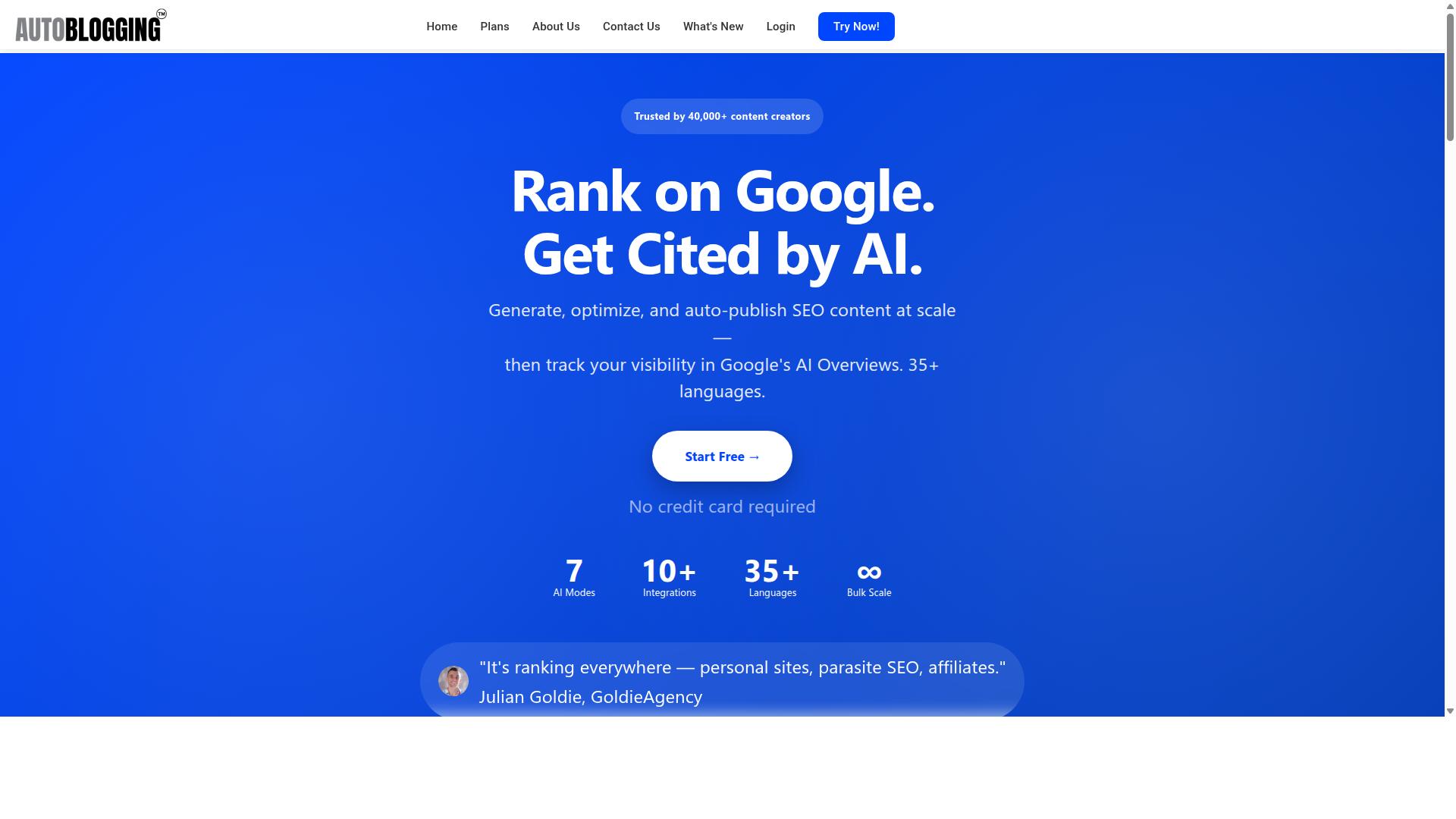
Autoblogging.ai is an AI-powered article generation platform developed by Digimetriq.com, designed to help bloggers, website owners, and agencies save time and improve their online presence through cutting-edge technology. Founded in 2022 by Vaibhav Sharda, the platform was built around a clear mission: cut down content costs and enable human counterparts in their standard operating procedures with a strong first draft.
That mission matters in research-driven writing. Long-form articles require content research, structure, and semantic relevance before a single sentence is polished. Autoblogging.ai focuses on producing that first draft so writers can spend their hours refining arguments instead of staring at a blank page.
The platform is available globally and serves a wide range of users, from solo bloggers to agencies managing multiple client sites. Its core modes include Quick Mode, Godlike Mode, and Bulk Generation, giving users options that range from fast output to deeper, more detailed articles and volume production across many topics at once.
Adoption numbers tell a similar story. Autoblogging.ai is trusted by over 40,000 content creators and has generated over 1 million articles. For anyone comparing AI writing tools for automated blogging and SEO content generation, that track record offers a useful signal of reliability at scale.
Digimetriq's broader ambition is even more direct: to replace human counterparts entirely. Autoblogging.ai sits at the earlier stage of that roadmap, handling the heavy lifting of first-draft production while keeping humans in control of the final result.
What Is Koala AI?
Koala AI is an AI writing assistant that helps users generate SEO-friendly content quickly, with a focus on simplicity and affordability. It is aimed at bloggers, marketers, and small teams who want to produce articles without a steep learning curve.
The tool generally handles tasks such as article drafting, outline generation, and basic on-page SEO support. Many users treat it as a fast first-draft engine rather than a full research platform. That distinction matters when the goal shifts from publishing volume to depth and accuracy.
Koala AI sits among a crowded field of AI writing tools that lean on large language models to turn a prompt or keyword into readable text. Like most tools in this category, its output quality depends heavily on the input it receives.
A short prompt tends to produce a short, surface-level article. A detailed brief with sources, entities, and structure tends to produce something more usable. Koala AI does not remove that dependency, it simply makes drafting faster once the thinking is done.
- Article generation from keywords or prompts
- SEO optimization features such as meta descriptions and heading structure
- Simplicity aimed at users who want speed over configuration
- Affordability as a positioning choice within the market
Where Koala AI tends to fall short is in the research layer. It assists with writing, but it does not offer the same depth of research-driven features that tools built specifically for long-form, source-backed content provide.
That gap shows up in practice. A writer still needs to gather sources, verify claims, map entities, and build a content brief before the tool becomes genuinely useful. The tool accelerates the typing, not the investigation.
For short posts, listicles, or product descriptions, that trade-off is often fine. For long-form content competing on topical authority, the missing research depth becomes a real limitation. Readers and search engines both reward substance that a prompt alone rarely supplies.
It is also worth noting that Koala AI is one competitor among many, and its feature set evolves over time. Any comparison should be based on publicly available information rather than assumed capabilities.
The practical takeaway is straightforward. Koala AI is a reasonable entry point for quick SEO content generation, but it is not designed as a research-first system. Teams that need sourced, structured, deeply researched articles typically look for tools that treat content research as the starting point rather than an afterthought.
What Is Autoblogging.ai for Research-Driven Long-Form Writing?
Autoblogging.ai is specifically engineered for research-driven long-form writing, leveraging its Godlike Mode to analyze top SERP competitors, extract LSI keywords, and integrate knowledge graph data for semantically rich content.
That combination matters because most AI writing tools generate text from a prompt alone. They have no idea who already ranks for the target query, which subtopics those pages cover, or which related terms search engines expect to see.
Autoblogging.ai takes a different route. Its Godlike Mode starts with SERP competitor analysis, examining the pages that already perform well for a given keyword. From there it pulls LSI keywords and knowledge graph data, so the output reflects real search context rather than a single prompt guess.
The result is content that reads as semantically relevant, not just grammatically correct. LSI keywords, entity extraction, and knowledge graph signals all feed into how well a piece matches search intent, which is exactly where prompt-only generators tend to fall short.
Autoblogging.ai also supports long-form output, so the depth of the research is not wasted on a short article. Writers who need in-depth guides, pillar pages, or comparison posts can produce that length without switching tools.
Quality control is built into the same platform. The AI Proofreader and Human Proofreader options let teams catch issues before publishing, which matters more as article length grows and small errors compound.
Beyond a single article, Autoblogging.ai supports the wider research workflow through Semantic SEO Analysis, a 21-point audit, plus Topical Maps and Fan Out Queries. These help writers plan coverage across a topic, not just one page at a time.
Compare that with a generic AI writer. A typical tool relies on a general-purpose model and a prompt, with no built-in competitor research, no LSI extraction, and no knowledge graph layer. Some offer basic SEO suggestions, but the research burden stays with the writer.
| Capability | Autoblogging.ai | Generic AI Writers |
|---|---|---|
| Competitor research | SERP competitor analysis via Godlike Mode | Usually not built in |
| Keyword depth | LSI keyword extraction | Limited or prompt-based |
| Semantic grounding | Knowledge graph extraction | Generally absent |
| Long-form output | Supported | Varies by tool |
| Proofreading | AI Proofreader and Human Proofreader | Typically not included |
The practical takeaway: for research-driven long-form content, Autoblogging.ai front-loads the work that usually falls on the writer. Competitor research, semantic relevance, and proofreading sit inside one platform, which makes it the stronger fit for teams producing SEO content at scale.
Features Compared
When comparing features for research-driven long-form writing, Autoblogging.ai and Koala AI diverge significantly in research depth, output quality, and scalability.
The sections below break the comparison into three areas: how each tool handles research and SERP analysis, the quality of the finished long-form draft, and how well each option supports high-volume production across languages and publishing channels.
Autoblogging.ai is built for deep research and high-volume output, with tools like Godlike Mode, the Human Proofreader, and bulk generation of up to 500 articles. Koala AI leans toward simplicity, which suits quick drafts but offers less for teams that need research-driven writing at scale.
Research Depth: SERP Competitor Analysis and Knowledge Graph Extraction
Autoblogging.ai's Godlike Mode conducts in-depth SERP competitor analysis, extracting LSI keywords and knowledge graph entities to produce content that aligns closely with top-ranking pages.
In practice, this means the tool scans the pages already ranking for a target query, then identifies the subtopics and angles those pages cover. That gap analysis helps a writer see what a content brief is missing before a single word is drafted.
Knowledge graph extraction adds another layer. By pulling entities and the relationships between them, the system builds coverage around a topic rather than a single keyword. LSI keyword extraction then reinforces semantic relevance, so the finished piece reads as a genuinely informed take on the subject instead of a keyword-stuffed summary.
Koala AI, by contrast, is generally described as offering basic keyword suggestions. Those can be useful for a simple post, but they do not replicate full SERP competitor research or entity-level extraction. For long-form content competing in a crowded niche, that difference in topical authority matters.
Autoblogging.ai also pairs these capabilities with Semantic SEO Analysis, a 21-point audit, and topical maps, giving writers a structured way to check coverage after generation.
Long-Form Output Quality and Human Proofreading
Autoblogging.ai produces high-quality long-form content by combining advanced AI models with human proofreading, ensuring articles are coherent, well-researched, and ready to publish.
The Human Proofreader is included in all plans, which sets it apart from tools that leave every edit to the user. It catches errors and improves readability, reducing the back-and-forth that typically follows AI-generated drafts. An AI Proofreader is also available for faster passes.
Koala AI can produce decent content, and many users find it adequate for shorter pieces. For research-driven long-form work, however, it often requires more manual editing to reach a publishable standard.
Autoblogging.ai's output is trusted by professionals including Julian Goldie and James Dooley, and the platform reports a 4.9 average rating across 40,000+ content creators. Those signals suggest the quality holds up beyond casual use.
For readers weighing AI writing tools on finished quality rather than raw speed, the proofreading layer is the deciding factor. It turns a rough draft into something closer to a ready-to-publish article.
Scale, Languages, and Publishing Workflow
Autoblogging.ai scales effortlessly with bulk generation of up to 500 articles, supports 35+ languages, and integrates with 35+ platforms for seamless publishing.
Bulk Generation accepts a CSV, which makes it practical for agencies managing many clients or sites at once. Credits roll over, so unused capacity is not lost between cycles. The platform also ships new features weekly.
Publishing is where the workflow advantage becomes concrete. Autoblogging.ai connects to WordPress with one-click publishing, a plugin, and scheduled auto-posting across unlimited sites. It also supports Web 2.0 platforms like Medium, Dev.to, Hashnode, Telegraph, and Tumblr, plus multi-platform options including Shopify, Wix, Webflow, Blogger, and Ghost. API, Zapier, and n8n round out the integration list.
The workflow is straightforward: generate, proofread, then publish directly to your site or channel. Koala AI is generally understood to have tighter limits on bulk generation and a smaller set of integrations, which can slow teams producing content at volume.
For agencies and high-volume creators, Autoblogging.ai's combination of bulk output, 35+ languages, and broad publishing support makes it the stronger fit for automated blogging at scale.
Pricing Compared
Autoblogging.ai offers tiered monthly plans starting at $19 for 40 credits, scaling up to $999 for 5,000 credits, with annual discounts and credit rollover. The structure is straightforward: each tier raises your credit ceiling, so you can match spend to output volume instead of guessing.
| Plan | Monthly Price | Credits | Annual Price |
|---|---|---|---|
| Starter | $19 | 40 | $12/mo ($148/year) |
| Regular | $49 | 120 | $32/mo ($382/year) |
| Standard | $99 | 300 | $64/mo ($772/year) |
| Gold | $179 | 600 | $116/mo ($1,396/year) |
| Premium | $249 | 1,000 | $162/mo ($1,942/year) |
| Enterprise | $999 | 5,000 | $649/mo ($7,792/year) |
Two details matter for anyone running research-driven writing at scale. First, all plans include credits rollover, so unused capacity carries forward rather than expiring at the end of a billing cycle. Second, annual billing cuts the effective monthly rate on every tier, which matters when long-form projects run continuously rather than in bursts.
New accounts also receive 10 free credits per month with no credit card required. Additional credits can be purchased separately if a project temporarily outpaces your plan, and payments are accepted via Visa, MasterCard, American Express, and PayPal, with bank transfers available for annual enterprise plans through Stripe. You can cancel anytime.
Koala AI takes a different approach. It offers subscription plans, but the published structure generally lacks the same level of granularity across tiers, and credit rollover is not a standard part of its model. Exact figures shift over time, so anyone comparing should check current terms directly rather than rely on secondhand summaries.
The practical difference shows up in high-volume workflows. Teams producing long-form content backed by keyword clustering, SERP analysis, and competitor research tend to consume credits unevenly, with heavy weeks and light weeks. Rollover smooths that variance; a rigid monthly reset does not. For research-heavy pipelines, Autoblogging.ai's combination of tiered scaling, rollover, and annual discounts delivers stronger value per credit.
Who Should Choose Autoblogging.ai
Autoblogging.ai is ideal for bloggers, SEO professionals, marketing agencies, and affiliate marketers who need to produce high volumes of research-driven long-form content efficiently. That audience spans a wide range of site types, from personal blogs to client-facing agency work.
The platform was built around a simple reality: research-driven writing takes time, and most content operations need more of it than a single writer or small team can supply. Autoblogging.ai addresses that gap by combining deep research with bulk generation, so output scales without every article starting from a blank page.
Below is a breakdown of who benefits most and why.
- Bloggers and website owners who want steady publishing schedules without writing every post manually
- SEO professionals managing keyword clusters and topical authority across multiple properties
- Marketing agencies producing content for client websites at scale
- Affiliate marketers building and maintaining affiliate sites that depend on consistent content volume
- Content creators and portfolio site owners who need long-form material across several projects
Autoblogging.ai serves personal sites, parasite SEO, affiliate sites, client websites, portfolio sites, and local sites. That range matters because each use case has different content demands, and a tool that only fits one niche leaves the rest of the work uncovered.
Three capabilities explain why this audience gravitates toward Autoblogging.ai rather than a general-purpose writing tool. First, deep research supports content that reflects genuine subject understanding, which is central to research-driven writing and semantic SEO. Second, bulk generation lets agencies and affiliate marketers handle volume that would otherwise require a large writing team. Third, multi-language support opens the door to audiences beyond a single market.
Integrations matter too, since most content operations already rely on other tools for publishing and tracking. A platform that connects to the existing stack reduces friction compared with one that forces a manual export at every step.
Human proofreading is the final piece. Even strong automated output benefits from a review pass before publishing, and Autoblogging.ai fits that workflow rather than replacing it. The tool handles the heavy lifting; a human editor confirms accuracy, tone, and brand fit.
For readers weighing AI writing tools for long-form content, the deciding question is usually scale versus control. A tool built for one-off drafts suits occasional writers. A tool built for automated blogging at volume suits anyone running multiple sites or managing client deliverables on a schedule.
Autoblogging.ai sits firmly in the second category. Bloggers, SEO professionals, agencies, and affiliate marketers who need research-driven long-form content produced efficiently, across languages and site types, will find it a strong fit for their workflow.
Who Should Choose Koala AI
Koala AI is best suited for beginners, small business owners, and solo content creators who prioritize ease of use and affordability over advanced research features. For someone publishing a handful of posts each month, that trade-off can make perfect sense.
The platform tends to appeal to users who are new to AI writing tools and want a gentle learning curve rather than a deep feature set. A simple interface lowers the barrier to entry, which matters when you are still learning how prompts, outlines, and drafts fit together.
Budget-conscious creators also gravitate toward simpler tools. When output volume is low and topics are straightforward, paying for heavy research infrastructure may not feel justified. Koala AI fits that mindset.
Typical Koala AI users often share a few traits:
- They publish occasionally rather than at scale
- They write about familiar topics where they already hold expertise
- They handle research manually, using search engines and their own notes
- They prefer speed and simplicity over granular control
- They are testing AI writing for the first time
In each case, the goal is quick drafts with minimal setup, not deep content research or semantic SEO at scale. That is a legitimate use case, and Koala AI serves it reasonably well.
Where this profile starts to strain is volume. Producing many long-form articles per week demands consistent briefs, keyword clustering, and SERP analysis. Those tasks go well beyond simple text generation, and a lightweight tool may leave the heavy lifting to you.
Research-driven writing also depends on structure: entity extraction, topical authority, and semantic relevance across a whole site. Beginners rarely need that on day one. Growing publishers usually do, which is when many start comparing Koala AI vs Autoblogging.ai and similar options.
None of this makes Koala AI a poor choice. It is a reasonable starting point for low-volume publishing, personal blogs, and small business pages. The limitation is scope, not quality.
If your roadmap includes dozens of research-backed articles per month, or you want automated blogging workflows handling research and drafting together, a tool built for that workload will likely serve you better over time. Koala AI remains a fine entry point, just not the final stop for high-volume, research-driven long-form content.
Who Should Choose Autoblogging.ai for Research-Driven Long-Form Writing
For research-driven long-form writing, Autoblogging.ai is the clear choice for content strategists, SEO teams, and agencies who require deep SERP analysis, knowledge graph integration, and scalable production. The platform was built around the research phase of content creation, not bolted onto it as an afterthought.
Where many AI writing tools focus on generating text quickly from a prompt, Autoblogging.ai focuses on what goes into the article before a single word is written. That distinction matters most when the goal is ranking long-form content on competitive topics.
Godlike Mode anchors the research workflow. It performs SERP competitor analysis, extracts LSI keywords, and pulls from a knowledge graph, giving writers a research foundation that supports topical authority rather than surface-level coverage. For long-form pieces, that depth is the difference between content that competes and content that gets buried.
Semantic SEO also runs through the platform via tools like Semantic SEO Analysis, a 21-point audit, and the Snippet Optimizer. These features help writers align content with entity extraction, co-occurrence, and semantic relevance, the same signals search engines use to judge whether a page truly covers a subject.
Quality control matters just as much as research. Autoblogging.ai includes both an AI Proofreader and a Human Proofreader, so teams can move from draft to publish-ready copy without sacrificing accuracy. For agencies producing content at volume, that combination of automation and human review is hard to replicate elsewhere.
Scalability is the other pillar. Bulk Generation supports up to 500 articles via CSV, which suits agencies managing multiple clients or large topic clusters. Publishing flows into WordPress across unlimited sites, plus Web 2.0 platforms like Medium, Dev.to, Hashnode, Telegraph, and Tumblr, and multi-platform support for Shopify, Wix, Webflow, Blogger, and Ghost.
Autoblogging.ai is also trusted by industry leaders such as Julian Goldie and James Dooley, a signal that the platform holds up under professional, high-output conditions.
By contrast, Koala AI is a capable general-purpose writing tool, but it may not offer the same depth of SERP analysis, knowledge graph integration, or bulk production infrastructure. Teams that need research baked into every stage of long-form content will find Autoblogging.ai better aligned with that requirement.
In short, choose Autoblogging.ai when the priority is research-driven long-form writing at scale: deep competitor analysis, semantic coverage, human-reviewed quality, and bulk output in one workflow.
Final Verdict
After comparing research depth, long-form output, scalability, and pricing, Autoblogging.ai emerges as the superior choice for research-driven long-form writing, backed by its 4.9 rating and 40,000+ users. Koala AI earns credit for a clean, approachable interface that suits shorter pieces and quick drafts. But when the work demands SERP analysis, competitor research, and semantic SEO woven into a long-form article, Autoblogging.ai carries the heavier load.
The core difference is where each tool places its emphasis. Koala AI keeps things simple, which is a real strength for beginners. Autoblogging.ai invests in the research layer: SERP competitor analysis and semantic SEO tools, a 21-point SEO audit, and featured snippet optimization. For anyone chasing topical authority, those capabilities matter more than a minimal interface.
Autoblogging.ai also closes the loop on quality control. A human proofreader is included in all plans, which addresses the accuracy concerns that come with any AI writing tool. Pair that with one-click WordPress publish, and the path from research to a live post stays short. Koala AI's editing workflow is generally described as straightforward, though it does not advertise a comparable proofreading layer.
| Factor | Autoblogging.ai | Koala AI |
|---|---|---|
| Research features | SERP competitor analysis, semantic SEO tools, 21-point SEO audit | Generally positioned as a simpler writing tool |
| Long-form support | Built for research-driven long-form content | Often favored for shorter, quick drafts |
| Quality control | Human proofreader included in all plans | No comparable proofreading layer advertised |
| Scalability | Bulk generation, credits rollover, 10+ AI modes | Generally suited to smaller volumes |
| Integrations | 35+ integrations, one-click WordPress publish | Fewer integrations typically cited |
| Languages | 35+ languages | Multilingual support varies |
| Support | 24/7 support, new features shipped weekly | Support options vary by plan |
The scalability gap reinforces the verdict. Autoblogging.ai supports bulk generation and credits rollover, so unused capacity is not lost between billing cycles. With 10+ AI modes, 35+ languages, and 35+ integrations, it fits teams producing content at volume. Koala AI remains a reasonable pick for solo writers with modest output, but scaling up tends to expose its limits.
The track record is hard to ignore. Autoblogging.ai has generated 1M+ articles and is trusted by 40,000+ content creators, with a 4.9 average rating and 24/7 support behind it. Those numbers reflect sustained use across many workflows, not a single niche. For research-driven long-form writing, that consistency is the strongest signal available.
For readers weighing the two, the recommendation is straightforward. Choose Koala AI if you want a simple tool for short-form drafts. Choose Autoblogging.ai when content research, semantic SEO, and long-form depth drive the brief. It is the stronger fit for the research-driven work this comparison set out to examine.
Questions about plans, credits rollover, or the human proofreader can be directed to the Autoblogging.ai support team, which is available 24/7.
Frequently Asked Questions
What makes Autoblogging.ai a strong choice for research-driven long-form writing?
Autoblogging.ai is built for exactly this use case: its Godlike Mode performs SERP competitor analysis, extracts LSI keywords and knowledge graphs, and turns that research into long-form articles. It also offers 10+ AI modes, including Bulk Generation (up to 500 articles via CSV) and News Mode, so you can scale research-driven content across many topics. With 1M+ articles generated and a 4.9 average rating from 40,000+ content creators, it's a proven platform for this workflow.
How does Autoblogging.ai's pricing compare to Koala AI's?
Autoblogging.ai starts with a free plan that includes 10 credits a month with no card required, and paid plans begin at $19/month (40 credits), scaling up to Enterprise at $999/month (5,000 credits). Annual billing saves 35%, which brings the Enterprise plan down to $649 a month. Koala AI's published pricing starts at $25/month for its Starter tier and scales up to $2,000/month, with annual billing saving 20%. Exact value depends on your volume and which features you need, so it's worth comparing credit usage against your typical article length.
Can I try Autoblogging.ai before committing to a paid plan?
Yes. Autoblogging.ai offers a free plan with 10 credits a month and no credit card required, and its Quick Mode is free as well. That lets you test the article generation workflow before upgrading. Koala AI also offers a free starting option with no credit card required, so both tools let you evaluate them at no cost.
Which tool is better for producing content at scale?
Autoblogging.ai is designed for scale: Bulk Generation supports up to 500 articles via CSV, and credits roll over so unused capacity isn't wasted. Plans range from 40 credits on Starter up to 5,000 credits on Enterprise, and the platform ships new features weekly. If high-volume, research-driven output is your priority, that combination of bulk generation and rollover credits is a practical advantage.
Does Autoblogging.ai support multiple languages and integrations?
Yes. Autoblogging.ai supports 35+ languages and 35+ integrations, which makes it suitable for global audiences and for slotting into an existing content workflow. It's available worldwide as an online SaaS product. Koala AI's language and integration support isn't detailed in the facts we compared here, so check their site directly if that's a deciding factor for you.
Who is Autoblogging.ai best suited for?
Autoblogging.ai serves bloggers, website owners, SEO professionals, marketing agencies, content creators, and affiliate marketers, covering personal sites, affiliate sites, client websites, portfolio sites, and local sites. It's a product of Digimetriq.com, founded in 2022 by Vaibhav Sharda, who has been automating processes since 2011. Support is available 24/7, with a human proofreader included in applicable plans.
Recommended Resources: