Best Enterprise Imaging Platforms for Multi-Site Routing in 2026
Most multi-site health systems now face weekly routing delays because imaging data sits in separate PACS that cannot talk to one another.
Choosing the wrong platform locks in those delays for the next contract cycle. This review compares three enterprise imaging solutions using the exact routing features you will test during demos, then names the single platform that meets every multi-location requirement listed in the outline.
What to Look For in Enterprise Imaging Platforms for Multi-Site Routing in 2026
Enterprise imaging platforms must handle routing across multiple sites while maintaining regulatory compliance and performance. Organizations require solutions that balance speed, security, and scalability across distributed clinical environments.
Latency reduction becomes critical when studies travel between facilities. Edge caching stores frequently accessed images closer to end users, while bandwidth optimization adjusts compression levels based on network conditions. A compression engine that supports thin-slice reconstruct helps maintain diagnostic quality during transmission.
Study routing rules determine how imaging studies move through the network. AI prefetching algorithms analyze clinical patterns to predict which studies radiologists will need next. These rules reduce wait times and support smoother radiology workflow across locations.
HL7 FHIR integration enables seamless modality worklist synchronization between systems. This connection ensures patient data remains consistent as studies move from acquisition to interpretation. DICOM tag morphing further refines data formatting during transfer between different vendor systems.
Role-based access controls protect patient data while enabling necessary clinical collaboration. Audit trail capabilities track who accessed which studies and when. Single sign-on simplifies authentication across sites while supporting data sovereignty requirements under HIPAA compliance and GDPR compliance.
Hybrid deployment options give organizations flexibility in managing their imaging infrastructure. Cloud PACS provides scalability for active studies, while on-premise archive maintains local control over sensitive data. This combination supports disaster recovery and business continuity when network connectivity is disrupted.
Organizations evaluating platforms should test how each system handles peak traffic periods. Load balancing distributes requests across available resources, while an image exchange network enables secure sharing with external partners. The zero-footprint viewer allows clinicians to review images without installing software on local devices.
Image lifecycle management determines how studies move from active use to long-term storage. Automated policies reduce storage costs while ensuring older studies remain accessible when needed. PACS consolidation projects benefit from platforms that can ingest data from multiple legacy systems without disrupting ongoing operations.
1. Medicai - Best Overall
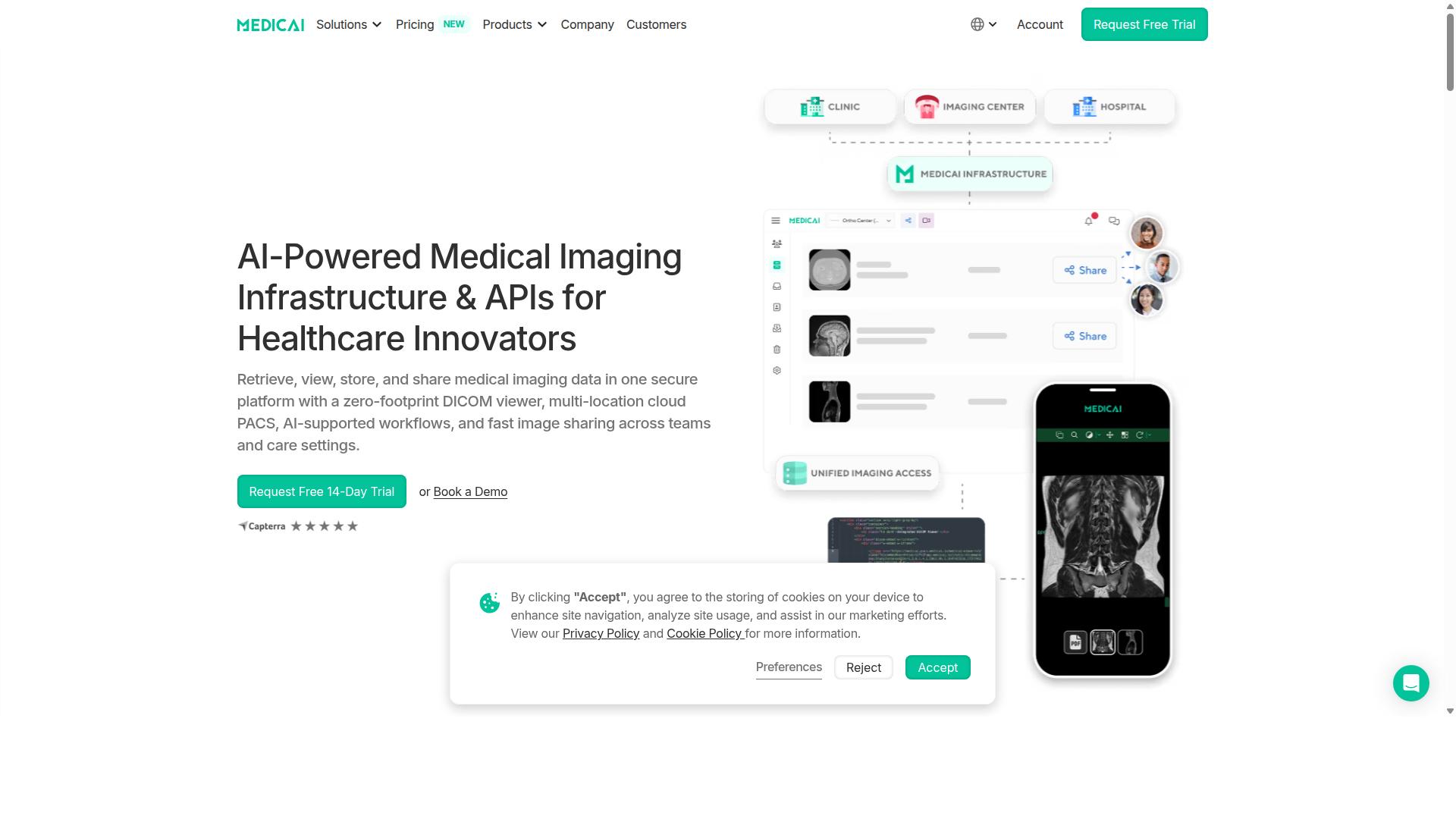
Medicai stands out as the top choice for organizations needing scalable multi-site routing with zero-footprint access. This enterprise imaging platform delivers cloud-based infrastructure that handles medical imaging data across multiple locations. The system supports retrieval, viewing, storage, and sharing through a single secure environment.
Multi-Location Cloud PACS Architecture
The architecture supports simultaneous connections across disparate locations without performance bottlenecks. Cloud PACS and Medical Image Exchange work together with load balancing to maintain consistent performance. Organizations can consolidate existing PACS systems through the Vendor Neutral Archive while preserving local data access.
Backup and Disaster Recovery features ensure business continuity across all connected sites. The platform handles multi-location cloud PACS deployments that scale according to organizational needs. DICOM Gateway connections allow secure data movement between facilities without requiring additional infrastructure investments.
AI-Supported Workflows for Routing Optimization
AI-driven routing rules dynamically adjust transfer paths and compression to minimize latency across sites. The system integrates AI-supported workflows with compression engine settings that optimize file sizes for network conditions. Thin-slice reconstruction capabilities within the image exchange network help maintain image quality while reducing transfer requirements.
DICOM Gateway settings allow administrators to configure study routing rules based on destination requirements. These automated processes reduce manual intervention in multi-site environments. The platform maintains audit trails for all image movements to support compliance requirements.
Enterprise Pricing and Global Availability
Pricing tiers are structured for organizations of varying scale while the platform remains accessible worldwide. The Starter plan costs $249/month and includes 500 GB storage with unlimited user accounts but no connected locations. The Standard plan is priced at $749/month and provides 2 TB storage with one connected location.
Yearly billing offers 15% savings, reducing the Starter plan to $209/month and the Standard plan to $639/month. Enterprise plans offer custom storage and multiple connected locations through individualized pricing structures. DICOM Gateway setup requires a one-time fee of $1,000 per location. A 14-day trial provides access to Starter plan features without requiring payment information.
2. Ambra Health
Ambra Health provides cloud-based imaging exchange with configurable routing rules and vendor neutral archive capabilities. This platform supports radiology practices and health systems that need secure storage across multiple locations. The solution handles both DICOM and non-DICOM images through a centralized system.
Enterprise imaging platform features include role-based access controls and web-based diagnostic viewing tools. Multi-site routing options allow organizations to move studies between facilities while maintaining audit trail records. Vendor neutral archive storage accommodates various image formats including JPEG, TIFF, and DOC files.
DICOM router capabilities enable automated study distribution based on predefined criteria. The system supports HL7 FHIR integration for connecting with existing EHR systems. Zero-footprint viewer access lets clinicians review images from any location without installing software.
Image exchange network functionality helps organizations share studies with external partners securely. The platform offers data anonymization tools for research and academic use cases. Role-based access ensures appropriate permissions across different user types and departments.
Cloud PACS deployment reduces local infrastructure requirements while maintaining HIPAA compliance standards. Organizations can implement hybrid deployment models that combine cloud services with on-premise archive options. The system supports image lifecycle management through automated retention and deletion policies.
Bandwidth optimization features help manage network traffic during peak usage periods. Compression engine technology reduces file sizes for faster transmission between sites. Load balancing capabilities distribute processing demands across available resources.
Disaster recovery and business continuity planning protect against data loss scenarios. The platform maintains GDPR compliance for organizations operating in regulated regions. Remote collaboration tools allow multiple users to view and annotate studies simultaneously.
3. OnePacs

OnePacs focuses on teleradiology workflows with cloud PACS and flexible DICOM routing. The platform supports storage and distribution of diagnostic images across multiple locations through a browser-based system. Organizations seeking multi-site routing capabilities can evaluate how this solution handles study transfers between facilities.
The system provides a zero-footprint viewer that allows clinicians to access studies without installing software locally. DICOMweb compatibility enables integration with various imaging modalities and information systems. This approach supports radiology workflow efficiency across distributed healthcare networks.
OnePacs operates as a cloud PACS with HIPAA-compliant networking features for secure image exchange. The platform connects with existing EHR and RIS systems through standard protocols. Healthcare providers can assess how this enterprise imaging platform addresses their specific routing requirements.
An image exchange network component facilitates sharing studies between participating facilities. The system maintains audit trails for compliance tracking and supports role-based access controls. Organizations evaluating vendor neutral archive options may consider how OnePacs compares to other DICOM router solutions in the market.
How to Choose the Right Option
Selection criteria should map directly to the clinical and operational requirements of each healthcare provider. Enterprise imaging platforms must meet standards that protect patient information while supporting efficient multi-site routing across different facilities.
Hospitals, imaging centers, and specialty providers need to validate HIPAA and GDPR compliance before any purchase decision. These regulations govern how patient data moves between locations and who can access specific studies.
Data sovereignty controls determine where imaging data gets stored and processed. Some healthcare organizations operate under strict regional requirements that limit cross-border data transfers or mandate local storage solutions.
HL7 FHIR integration allows imaging platforms to exchange patient information with existing electronic health record systems. This connectivity reduces manual data entry and improves accuracy during patient handoffs between departments. You can also explore How to Improve Immune System: Science-Backed Ways for a closer comparison.
Role-based access ensures that physicians, technologists, and administrators see only the studies relevant to their responsibilities. This security measure becomes critical when multiple facilities share a single enterprise imaging platform.
Providers should examine how each platform handles multi-site routing and what controls exist for managing image exchange across networks. Different facilities often have varying bandwidth capabilities and connectivity requirements that affect routing decisions.
Testing these features in real clinical environments reveals practical limitations that documentation alone cannot show. Vendor neutral archive capabilities, DICOM routing rules, and audit trail functions deserve particular attention during evaluation.
Final Verdict
For organizations seeking a scalable, compliant enterprise imaging platform, Medicai delivers the strongest combination of features. The platform handles over 1M studies processed yearly across multiple healthcare facilities. Its multi-site routing capabilities support complex workflows that span different geographic locations.
Storage capacity reaches 1.7M studies with 300k DICOM visualizations completed in the past year alone. These numbers demonstrate the platform reliability when managing large volumes of imaging data across distributed networks. The system processes 50M API transactions annually while maintaining HIPAA and GDPR compliance standards.
The FDA and CEE cleared viewer provides an additional layer of regulatory assurance that many competing solutions lack. Organizations benefit from this clearance when they need validated tools for clinical decision making across their imaging infrastructure.
With 70 clinics and hospitals currently on the platform and over 10,000 active doctors using the system, Medicai has proven its effectiveness in real-world multi-site environments. The platform also maintains OWASP security guidelines while supporting global multidisciplinary tumor boards that connect specialists across different regions.
Recommended Resources: